The Digital Highway Is Here
The global freight industry is undergoing a transformation — not just in how goods are moved, but in how trucks think, connect, and make decisions.
Autonomous and semi-autonomous trucks are rapidly evolving into rolling data centers, powered by edge computing and next-generation 5G/6G connectivity.
This shift is redefining the backbone of logistics — making freight faster, safer, and more intelligent than ever before.
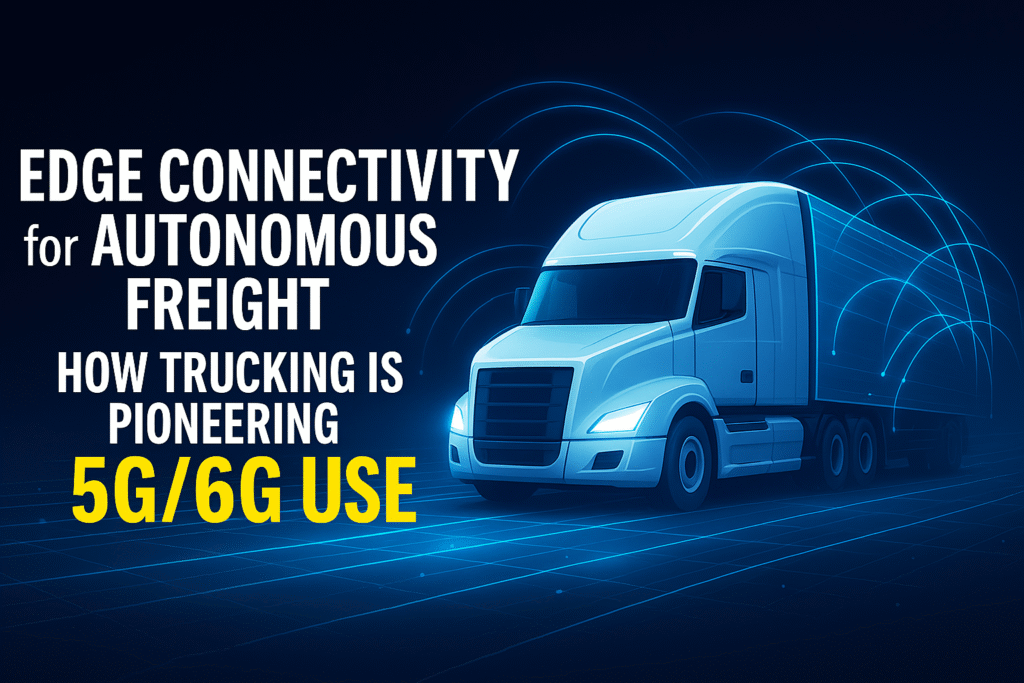
⚙️ How Edge and 5G/6G Are Changing Freight Operations
1. Real-Time Decisions at the Edge
Traditional cloud processing adds milliseconds of delay that can mean the difference between a safe stop and an accident.
With edge computing, sensor data — from cameras, radar, and LiDAR — is processed directly inside the vehicle or nearby roadside edge servers.
When paired with 5G’s ultra-low latency, trucks can now respond to obstacles, traffic, and route changes in milliseconds.
Read Also This: 🛫 Urban Air Mobility: How Cities Are Building the Ground Network for Flying Cars
2. Bandwidth for the Data-Heavy Truck
A single autonomous freight truck can generate terabytes of data per day. High-definition video, radar signals, GPS telemetry, and AI inference models all rely on constant connectivity.
5G and 6G networks provide the wide lanes this data needs — allowing trucks to upload insights to the cloud while maintaining edge autonomy on the road.
3. Network Slicing for Mission-Critical Reliability
With network slicing, telecom providers can dedicate secure bandwidth solely to autonomous freight.
That means convoys — or platoons of trucks — can communicate in real time without interference, creating safer, fuel-efficient formations that save up to 15 % in fuel costs.
4. Edge-Based Artificial Intelligence
Instead of waiting for cloud updates, AI models on edge nodes continuously learn from local traffic data, weather patterns, and road conditions.
Each vehicle becomes a smart agent, sharing real-time analytics with other trucks and control centers to improve overall logistics flow.
🛣️ Real-World Innovations on the Road
- Truck Platooning: Connected convoys use synchronized braking and acceleration, with edge nodes coordinating every move across lanes.
- Smart Corridors: Major highways are being outfitted with edge servers and 5G relays that monitor traffic density, weather, and maintenance needs.
- Predictive Maintenance: Sensors in the drivetrain and brakes send diagnostics to nearby edge systems, predicting component wear before breakdowns occur.
- Remote Assistance: In challenging environments, remote operators can step in instantly via high-bandwidth, low-latency connections — all thanks to edge computing.
- Dynamic Routing: Real-time data enables trucks to reroute around congestion or severe weather automatically.
🌐 Why Trucking Leads in 5G/6G Adoption
Unlike personal vehicles, freight fleets run on defined routes, often through industrial corridors — perfect for edge infrastructure deployment.
Logistics companies already rely on telemetry and IoT tracking; extending this ecosystem into edge-connected automation is a natural evolution.
Fleet operators see clear financial advantages:
- Reduced fuel costs through coordinated driving
- Fewer accidents from improved reaction times
- Greater efficiency in loading, routing, and delivery schedules
Trucking is proving to be a real-world testbed for 5G/6G innovation — where every mile generates actionable data.
⚠️ The Challenges Ahead
Even with rapid progress, several roadblocks remain:
- Infrastructure Costs: Building continuous 5G/6G coverage across rural freight corridors requires heavy investment.
- Data Security: Freight networks carry sensitive cargo information that must be protected from cyber-threats.
- Interoperability: Different truck brands, edge systems, and telecom vendors must work seamlessly together.
- Power Consumption: Balancing energy use between onboard AI, sensors, and connectivity modules is crucial for range and efficiency.
- Regulatory Standards: Cross-border consistency in data handling and autonomous freight laws is still evolving.
🔮 The Future of Connected Freight
- By 2026–27: Large logistics firms will roll out private 5G edge networks along major transport corridors.
- By 2028: Early 6G trials will expand high-frequency coverage, enabling near-instantaneous V2V (vehicle-to-vehicle) communication.
- By 2030: Fully autonomous, continuously connected freight fleets could operate coast-to-coast — monitored by AI-driven edge ecosystems.
As the technology matures, the freight industry will serve as the proving ground for global 6G connectivity — transforming logistics into one of the smartest, most responsive networks in the world.
✅ Conclusion
Edge connectivity, backed by 5G and soon 6G, is propelling freight transport into a new era of automation and intelligence.
By turning every truck into a self-aware, data-driven node, logistics companies are not just transporting goods — they’re powering the infrastructure of a smarter, faster, more connected world.

Azeem Aosaf is a visionary entrepreneur, digital strategist, and educator with a mission to empower individuals through online earning and digital innovation. As the CEO of HelixNex LLC, he leads multiple ventures across e-commerce, education, and fintech—helping people turn their digital skills into sustainable income. Through his educational initiative RankTrak, Azeem has trained hundreds of students in SEO, YouTube Automation, Freelancing, and AI-powered marketing. His work bridges technology and opportunity—creating a platform where learning meets real-world success. When he’s not mentoring students or building digital products, Azeem shares insights on entrepreneurship, marketing trends, and financial freedom through his blogs and social platforms. His core belief: “Your Growth, Our Mission.”