Introduction
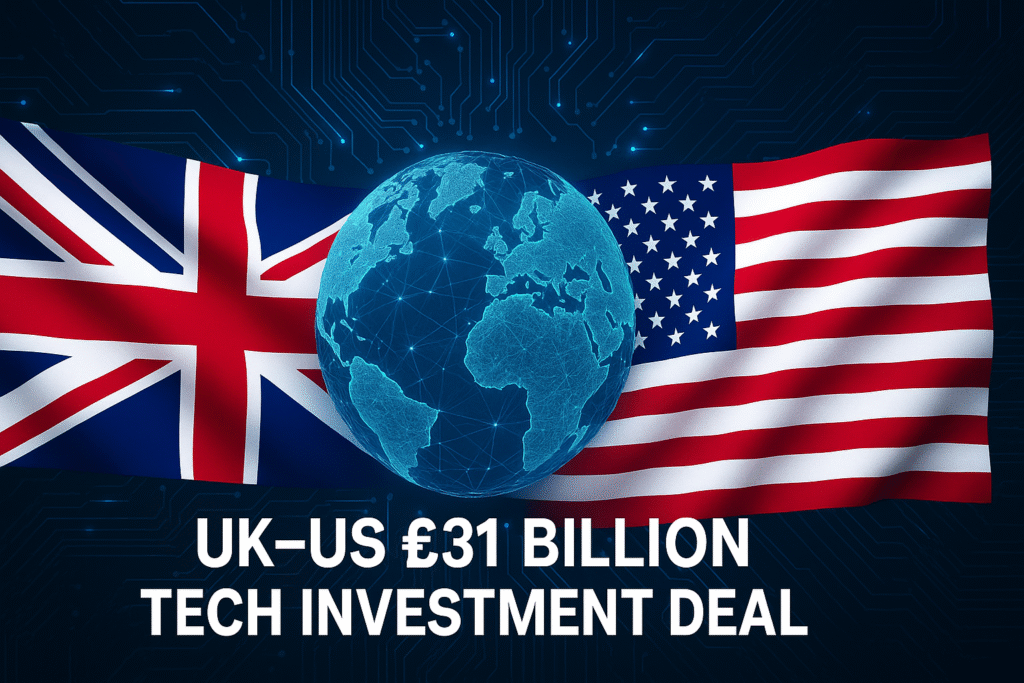
In a move that could redefine the global technology map, the United Kingdom and the United States have signed a monumental £31 billion technology investment deal focused on artificial intelligence, quantum computing, and digital infrastructure.
The agreement — dubbed the Tech Prosperity Partnership — is designed to strengthen transatlantic innovation and safeguard technological leadership amid growing competition from China and the European Union.
It’s not just about innovation; it’s about power, security, and economic growth in a rapidly digitalizing world.
1. Inside the UK–US Tech Prosperity Partnership
A First-of-Its-Kind Alliance
The £31 billion agreement brings together governments and tech industry leaders to advance next-generation research and infrastructure. The partnership will:
- Channel billions into AI and quantum research, supported by academic institutions in both countries.
- Fund cloud computing, cybersecurity, and 6G networks to build a resilient digital backbone.
- Develop a transatlantic framework for AI ethics, ensuring innovation aligns with human-centered values.
Read Also This: Bentley to Unveil Its First Fully Electric Model: A New Chapter in Luxury
Big Tech Joins Forces
Major technology firms are central to the initiative:
- Microsoft will invest heavily in AI data centers and supercomputing hubs in northern England.
- Google plans new cloud and clean-energy facilities across the UK.
- NVIDIA will help establish quantum simulation labs and GPU clusters for research.
- Amazon Web Services (AWS) will expand digital infrastructure for public and private sectors.
Together, these efforts position the UK as the AI capital of Europe and reinforce America’s technological dominance.
2. Why the Deal Matters
Reviving Post-Brexit Innovation
For the UK, this partnership offers a timely boost. After years of Brexit-related uncertainty, Britain now aims to transform itself into a global innovation hub. The deal will create tens of thousands of high-skill jobs, modernize digital infrastructure, and attract further investment.
Strengthening Transatlantic Ties
Politically, this agreement redefines the “special relationship” between the two nations — extending it from defense and diplomacy to shared digital sovereignty. It ensures that democratic nations maintain control over key technologies like AI and quantum computing, rather than ceding ground to authoritarian competitors.
Accelerating the AI Race
Both nations view AI as the next industrial revolution. The deal’s AI component will fund everything from language models and robotics to AI ethics testing and public-sector automation. The focus is not just on speed but safe and responsible innovation.
3. Quantum Computing: The Next Frontier
Quantum technology sits at the heart of this agreement. It holds the potential to redefine computing power, solving problems that today’s supercomputers can’t.
Under the deal:
- The UK will establish quantum research hubs in Oxford and Manchester.
- The US will provide expertise and hardware collaboration via national labs.
- Joint teams will develop quantum encryption and communication systems to protect sensitive data.
By pooling resources, both nations aim to achieve commercial quantum breakthroughs by 2030, ahead of global competitors.
4. Building the Digital Infrastructure of the Future
Beyond AI and quantum, the partnership emphasizes digital foundations that support these technologies:
- New data centers powered by renewable energy.
- 5G and emerging 6G networks to enhance connectivity across the UK.
- Cyber defense systems to secure government, energy, and finance sectors.
This infrastructure expansion not only strengthens national resilience but also enhances everyday digital life — from smarter cities to faster communication.
5. The Global Context: A Race for Tech Supremacy
Competing with China and the EU
China has been pouring billions into state-controlled AI and semiconductor programs, while the EU is championing digital sovereignty with heavy regulation.
The UK–US alliance represents a third path — open, ethical, and innovation-driven — combining Western innovation with democratic accountability.
Economic Impact
Analysts predict the partnership could add over £60 billion to the UK economy by 2030, making it one of the most profitable cross-border investments in modern history.
Stocks in semiconductor, AI, and cloud infrastructure firms have already surged following the announcement.
6. Opportunities and Challenges Ahead
Opportunities
✅ Job Creation: Thousands of roles in engineering, cybersecurity, and data science.
✅ Research Collaboration: Universities and startups gain unprecedented access to funding.
✅ Green Innovation: Sustainable data centers and renewable energy initiatives embedded in the plan.
Challenges
⚠️ Data Security: Managing transatlantic data flows while maintaining privacy standards.
⚠️ Corporate Power: Critics worry the deal could deepen dependence on US tech giants.
⚠️ Energy Demand: Data centers and quantum facilities require massive energy, pushing the need for clean power solutions.
Despite these hurdles, policymakers see the deal as essential for maintaining democratic control over emerging technologies.
7. What Happens Next
The first wave of investment projects will roll out in early 2026, starting with AI research hubs in London, Edinburgh, and Boston.
- By 2027, quantum labs and data centers will be operational.
- The Transatlantic Tech Council will oversee governance, ethics, and joint research.
- Annual reviews will measure progress, impact, and sustainability goals.
This is not a short-term initiative — it’s a 10-year roadmap to secure the future of Western innovation.
Conclusion
The UK–US £31 billion Tech Prosperity Partnership is more than just an investment — it’s a statement of intent.
In a world where technology defines power, this deal establishes a digital bridge across the Atlantic, ensuring that democratic innovation leads the next industrial revolution.
From artificial intelligence to quantum computing, the UK and US are not just keeping pace with change — they’re shaping the future together.
Frequently Asked Questions (FAQ)
Q1. What is the UK–US tech deal about?
It’s a £31 billion partnership focusing on AI, quantum computing, and digital infrastructure between the UK and US governments and major technology firms.
Q2. Which companies are participating?
Microsoft, Google, NVIDIA, and Amazon are leading contributors, alongside UK-based universities and innovation hubs.
Q3. When will the projects begin?
Initial rollouts start in 2026, with major AI and quantum facilities expected to go live by 2027.
Q4. How will this affect jobs in the UK?
The deal will create thousands of skilled roles in engineering, data analytics, and advanced research.
Q5. Why is this deal geopolitically significant?
It strengthens the UK–US alliance, ensuring Western nations retain leadership in key technologies against rising global competition.

Azeem Aosaf is a visionary entrepreneur, digital strategist, and educator with a mission to empower individuals through online earning and digital innovation. As the CEO of HelixNex LLC, he leads multiple ventures across e-commerce, education, and fintech—helping people turn their digital skills into sustainable income. Through his educational initiative RankTrak, Azeem has trained hundreds of students in SEO, YouTube Automation, Freelancing, and AI-powered marketing. His work bridges technology and opportunity—creating a platform where learning meets real-world success. When he’s not mentoring students or building digital products, Azeem shares insights on entrepreneurship, marketing trends, and financial freedom through his blogs and social platforms. His core belief: “Your Growth, Our Mission.”