A Tough Start to the Year for UK Automakers
The first six months of 2025 have tested the resilience of Britain’s automotive sector. Vehicle manufacturing across the UK has dipped sharply, with total output falling around 12% year-on-year, marking one of the toughest first halves since the pandemic.
While the decline reflects a challenging global climate — from supply disruptions to weakening demand — it also highlights an industry in transformation. The bright spot? The country’s growing strength in electric and hybrid exports, which continue to provide a crucial lifeline amid the slowdown.
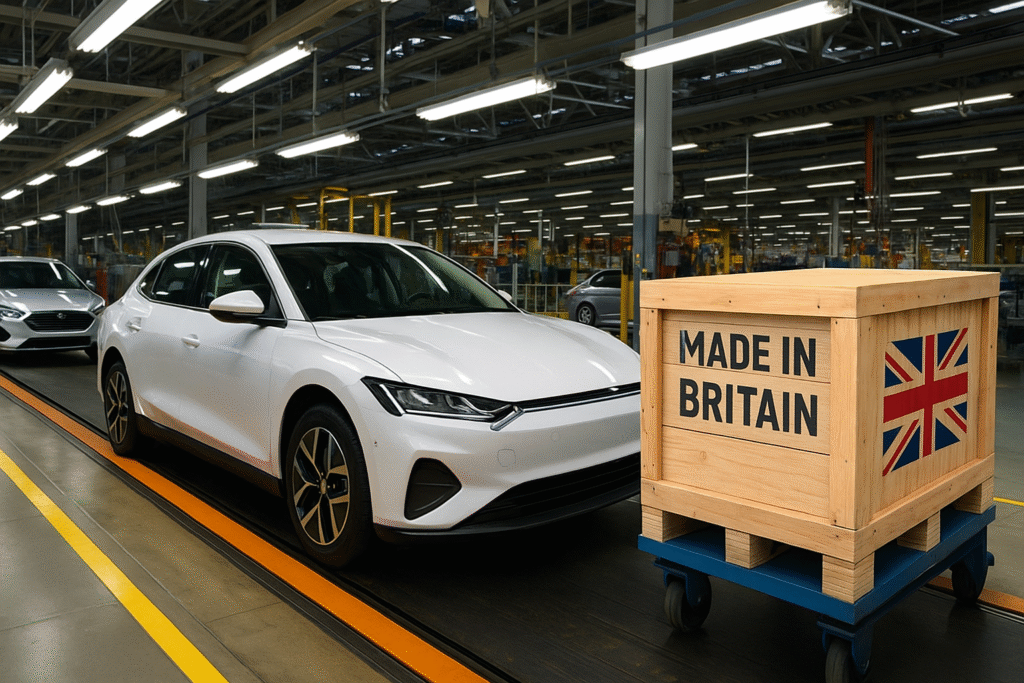
Breaking Down the Numbers
According to industry estimates and trade data, the UK’s total vehicle production (including both passenger cars and commercial vehicles) stood at roughly 417,000 units in the first half of 2025. That’s a drop of nearly 12% compared with the same period last year.
Read Also This: Changan Automobile Launches in the UK — Taking on Tesla’s EV Empire
🚗 Passenger Cars
Car production, which forms the backbone of UK automotive manufacturing, slipped by approximately 7%, with around 386,000 units produced between January and June.
🚚 Commercial Vehicles
The commercial vehicle sector fared worse, plummeting by more than 40%, largely due to plant retooling, model changeovers, and weaker demand for light vans across Europe.
⚡ EVs Outperform the Market
Despite the downturn, electrified vehicles (EVs, PHEVs, and hybrids) stood out. Their combined output rose to over 40% of total UK car production, a sign that Britain’s manufacturing base is steadily shifting toward electric mobility.
Why the Decline Happened
Several factors have contributed to the overall fall in UK vehicle production:
1. 🏭 Retooling for the EV Transition
Many British plants are in the middle of reconfiguring their production lines to build next-generation electric vehicles. While essential for long-term competitiveness, these transitions often mean temporary factory shutdowns or reduced shifts.
2. 🌍 Weak Global Demand
Economic uncertainty, inflationary pressures, and higher interest rates have dampened car-buying appetite worldwide. For an export-driven industry like the UK’s — where nearly 77% of cars are built for overseas markets — global weakness hits hard.
3. 📉 Commercial Vehicle Slump
With a drop in van and fleet orders, the commercial vehicle sector has seen one of its steepest declines in recent memory. Reduced activity in logistics and small business fleets has further limited demand.
4. 🚢 Supply Chain Disruptions
Lingering component shortages — particularly in semiconductors and battery materials — continue to affect production schedules. Although better than in 2023, supply volatility still prevents consistent output.
The Bright Spot: Electric Vehicle Exports
While overall production has fallen, electric and hybrid vehicles are keeping the UK auto industry from sliding further.
⚡ EVs Now Nearly Half of Output
Electric and hybrid vehicles together now represent more than two out of every five cars built in the UK — a major milestone that reflects both domestic policy and international demand.
🌐 Export-Driven Momentum
Roughly three-quarters of all UK-built cars are exported, with the EU, United States, and China among the biggest destinations. Demand for British-made EVs, including premium and performance models, has remained robust — especially as European buyers look for alternatives to Asian imports.
📦 Global Electrification Boost
As more countries tighten emission standards, demand for EVs continues to grow. British manufacturers are benefiting from this global shift, exporting models built on electric platforms from brands like Nissan, Mini, and Jaguar Land Rover.
Challenges the UK Auto Sector Still Faces
Even with EV growth offering relief, several challenges are holding the UK industry back from a full recovery:
⚠️ 1. Cost Competitiveness
UK factories face higher energy and logistics costs compared to European counterparts. Without government-backed incentives or industrial reforms, cost pressure could deter future investment.
⚠️ 2. Limited Battery Supply Chain
While EV exports are strong, the UK still lacks large-scale domestic battery gigafactories, forcing reliance on imports and increasing production costs.
⚠️ 3. Skilled Workforce Transition
Thousands of jobs need re-skilling for electric manufacturing. Without major workforce training programs, plants risk bottlenecks in adapting to new production technologies.
⚠️ 4. Market Uncertainty
Automakers are watching global trends closely — from trade tariffs to raw material prices — that could influence decisions on where to produce future EV models.
Why the Future Still Looks Promising
Despite short-term pain, experts believe the UK’s automotive sector is laying the foundation for long-term recovery.
✅ EV Investment Is Accelerating
Major brands, including Jaguar Land Rover, BMW Mini, Nissan, and Stellantis, are expanding their UK EV production capacity through billions in planned investments.
✅ Policy Alignment Is Improving
Government initiatives like the Zero Emission Vehicle (ZEV) mandate, which encourages manufacturers to increase electric output, are helping align national production targets with market demand.
✅ Export Potential Is Huge
With EV exports growing, the UK is well-positioned to become a specialized exporter of electric and hybrid vehicles to Europe, North America, and beyond.
✅ Green Industrial Growth
The focus on clean energy, battery recycling, and sustainable supply chains gives the UK a competitive edge in the race for green automotive innovation.
The Road Ahead: Rebuilding Momentum
If current forecasts hold, the UK’s vehicle production may end 2025 with a 10–15% annual decline, but experts predict a return to growth in 2026 as new EV models come online and retooled plants reach full capacity.
For an industry that employs over 160,000 people directly, recovery isn’t just about numbers — it’s about safeguarding a sector that has long been the pride of British manufacturing.
In short, while 2025 has started with a slowdown, it’s not the end of the road. If the UK continues to focus on EV innovation, trade agreements, and sustainable industrial policies, the country could soon drive back into the fast lane of global automotive leadership.
🔍 Frequently Asked Questions (FAQ)
Q1: How much did UK vehicle production fall in early 2025?
A1: Vehicle output dropped by around 12% in the first six months of 2025 compared with the same period in 2024.
Q2: What caused the decline in car manufacturing?
A2: Key factors include global demand weakness, plant retooling for EVs, supply chain shortages, and reduced commercial vehicle production.
Q3: How significant are EVs in UK car production now?
A3: Electric and hybrid vehicles now make up over 40% of total UK car production, showing strong progress toward electrification.
Q4: Which markets buy the most UK-built cars?
A4: The European Union remains the UK’s largest export market, followed by the United States and China.
Q5: When is the UK auto industry expected to recover?
A5: Analysts predict that UK car production will begin to rebound by mid-2026, as new EV models launch and retooled factories return to full production.

Azeem Aosaf is a visionary entrepreneur, digital strategist, and educator with a mission to empower individuals through online earning and digital innovation. As the CEO of HelixNex LLC, he leads multiple ventures across e-commerce, education, and fintech—helping people turn their digital skills into sustainable income. Through his educational initiative RankTrak, Azeem has trained hundreds of students in SEO, YouTube Automation, Freelancing, and AI-powered marketing. His work bridges technology and opportunity—creating a platform where learning meets real-world success. When he’s not mentoring students or building digital products, Azeem shares insights on entrepreneurship, marketing trends, and financial freedom through his blogs and social platforms. His core belief: “Your Growth, Our Mission.”