China’s new auto policy signals a shift from rapid expansion to controlled growth
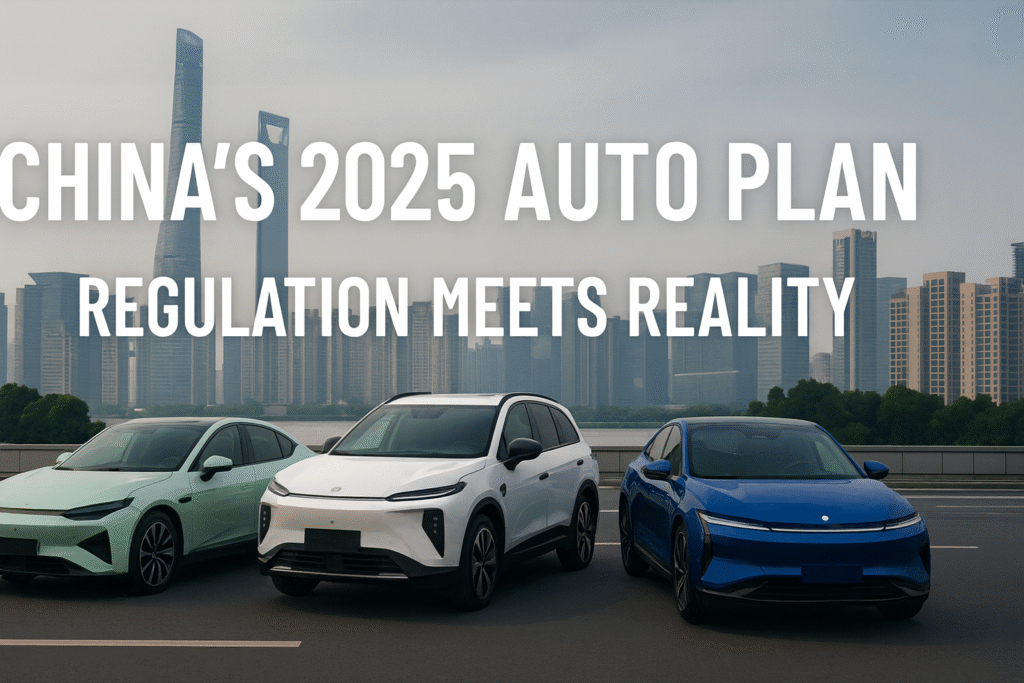
China, the world’s largest automotive market, has taken a cautious stance for 2025.
In its latest government plan, Beijing announced an auto sales target of 32.3 million vehicles — lower than industry forecasts — while outlining a series of measures aimed at stabilizing competition and enforcing tighter regulations.
This move marks a significant departure from the high-growth, high-volume approach that has driven China’s auto industry over the past decade.
📊 Lower Sales Goal Reflects Policy Realignment
Industry groups like the China Association of Automobile Manufacturers (CAAM) had expected total sales to exceed 32.9 million vehicles in 2025.
By setting a smaller goal, authorities appear focused on quality, efficiency, and long-term sustainability, rather than record-breaking output.
The plan also targets 15.5 million new energy vehicle (NEV) sales — including electric and plug-in hybrids — representing around 20% growth year over year.
Although this is below market predictions, it reinforces China’s intent to balance innovation with market stability, avoiding overproduction and price collapse.
⚙️ Regulatory Push: From Price Wars to Industry Discipline
The auto market in China has recently seen intense price wars, with dozens of brands competing for dominance through deep discounts and aggressive promotions.
In response, regulators have introduced new oversight policies to restore order and ensure fair competition.
Read Also This : U.S. Auto Market Soars in September as EV Buyers Rush to Beat Tax Credit Cutoff
Key Measures Include:
- Price control and anti-dumping oversight to prevent unsustainable discounting.
- Stricter advertising and transparency rules, limiting false claims and manipulative marketing.
- Enhanced consumer protection, including faster complaint resolution and warranty enforcement.
- Tighter EV subsidy checks to curb fraudulent claims and wasteful spending.
- Limited approval for Level 3 autonomous systems, ensuring safety readiness before mass rollout.
Officials have emphasized that the goal isn’t to slow down growth, but to prevent “irrational competition” that threatens long-term industry health.
🚗 Impact on Automakers and Global Markets
For Domestic Brands
Local giants such as BYD, Geely, and SAIC are expected to adjust production volumes and shift toward premium segments.
With stricter compliance standards, companies will need to invest more heavily in research, software integration, and safety testing — increasing costs but improving overall product quality.
For Foreign Manufacturers
International brands like Tesla, BMW, and Volkswagen may face more complex regulatory conditions but stand to benefit from a more predictable market environment.
China’s regulatory stabilization could reduce volatility in pricing, giving global automakers a clearer path for strategy and investment.
For Consumers
Buyers may see fewer short-term deals, but better reliability and service.
Government-backed trade-in incentives and subsidies for NEVs are expected to remain available, albeit at reduced levels.
⚡ China’s Balancing Act: Growth with Control
China’s 2025 plan showcases a balancing act — maintaining innovation momentum while safeguarding market structure.
The government’s message is clear: rapid expansion without control can no longer be the norm.
Analysts see this as a “maturity moment” for China’s automotive industry — where sustainable growth, export readiness, and stronger brand value take precedence over sheer numbers.
The decision also comes amid rising global scrutiny of China’s EV dominance, with the U.S. and Europe imposing new tariffs and trade restrictions.
By regulating output and ensuring fair practices, Beijing aims to deflect accusations of overproduction and maintain its global leadership responsibly.
✅ The Road Ahead
2025 will test how well China’s automakers can adapt to a slower, smarter market.
While the targets may seem conservative, the emphasis on quality, transparency, and discipline could lead to a more resilient automotive ecosystem — one that prioritizes innovation over speculation.

Azeem Aosaf is a visionary entrepreneur, digital strategist, and educator with a mission to empower individuals through online earning and digital innovation. As the CEO of HelixNex LLC, he leads multiple ventures across e-commerce, education, and fintech—helping people turn their digital skills into sustainable income. Through his educational initiative RankTrak, Azeem has trained hundreds of students in SEO, YouTube Automation, Freelancing, and AI-powered marketing. His work bridges technology and opportunity—creating a platform where learning meets real-world success. When he’s not mentoring students or building digital products, Azeem shares insights on entrepreneurship, marketing trends, and financial freedom through his blogs and social platforms. His core belief: “Your Growth, Our Mission.”