An unexpected blow to America’s biggest automaker
General Motors (GM), one of the leading voices in the electric vehicle (EV) revolution, has been hit with a major financial setback. The company recently confirmed it will take a $1.6 billion accounting charge following a reversal of U.S. federal EV tax credits that once helped fuel the market for electric cars.
This sudden change doesn’t just impact GM’s balance sheet — it also signals a broader challenge for the entire electric vehicle industry as it adjusts to a world with less government support and slower adoption rates.
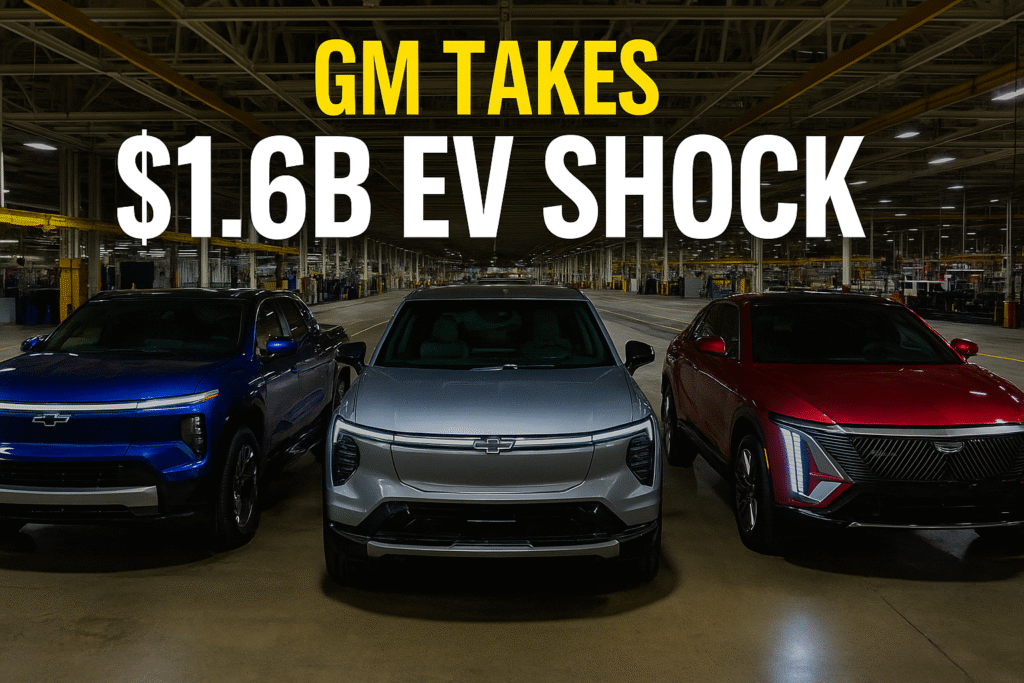
⚡ Why GM Is Taking a $1.6 Billion Hit
The charge reflects GM’s internal reassessment of its EV strategy after the loss of key tax incentives that once made electric models more affordable for American buyers.
Here’s how that amount breaks down, according to sources familiar with the company’s quarterly report:
- Factory and equipment adjustments (≈ $1.2 B) — GM is scaling back certain EV manufacturing plans and adjusting production capacity at multiple plants.
- Supplier and contract settlements (≈ $400 M) — The automaker is compensating suppliers for delayed or cancelled orders related to reduced EV output.
Essentially, GM is paying for its earlier optimism — investments made under the assumption that EV tax credits would continue long term have now turned into expensive liabilities.
🚘 How the EV Tax Credit Reversal Changed the Game
For years, U.S. buyers could claim up to $7,500 in federal credits when purchasing qualifying electric cars. That policy was central to automakers’ long-term electrification plans.
However, following the 2025 federal policy update, the credit structure was either reduced or removed for many manufacturers, including GM. As a result, EV prices effectively rose overnight, and sales momentum slowed sharply.
Without the incentive cushion, buyers are rethinking their decisions — many shifting toward hybrid or gas-powered vehicles, which remain cheaper upfront and easier to fuel.
🧭 What This Means for GM’s EV Plans
GM still intends to continue its EV push through brands like Chevrolet, GMC, and Cadillac, but the pace may slow down. Internal reports suggest the company is re-evaluating its production forecasts and trimming less profitable electric models.
While GM hasn’t announced any specific cancellations, analysts expect:
- Delayed launches for some upcoming EVs.
- Reduced production targets for premium models.
- A stronger focus on hybrids and plug-in variants that balance performance and affordability.
“GM isn’t abandoning electric,” one insider explained, “but they’re pivoting to survive the short-term storm.”
🏭 How Other Automakers Are Reacting
GM’s move has ripple effects across the industry. Companies like Ford and Stellantis are facing similar pressure, as the cost of EV development remains high while buyer enthusiasm cools without subsidies.
Some industry experts believe this could trigger a temporary slowdown in EV rollouts — not because demand is gone, but because the economics no longer work in the short term.
Expect to see:
- More affordable EVs under $40,000.
- Software-based revenue models to offset hardware costs.
- Regional diversification, with automakers targeting markets like Europe and China, where EV incentives remain strong.
💡 GM’s Strategy Going Forward
Even with this financial hit, GM isn’t stepping away from the future. Here’s how they’re repositioning:
- Balancing EVs with hybrids – Expect more hybrid options in the Chevrolet lineup to appeal to price-sensitive buyers.
- Streamlining factories – Underused EV assembly lines may be consolidated to reduce costs.
- Battery partnerships – GM is strengthening collaborations with suppliers for lower-cost battery production.
- Export expansion – The automaker plans to push more electric exports to regions that still offer subsidies.
- Lobbying for renewed incentives – Quiet discussions are underway with policymakers about new clean-energy credits.
Also Read: Top 10 Car Models That Are Trending Online — And Why
📉 Investor & Market Reaction
GM’s stock took a minor dip following the announcement but stabilized within a few trading sessions. Investors appear to view the move as a course correction rather than a collapse.
Still, the $1.6 B write-down underscores a growing concern: the road to full electrification will be slower, costlier, and less predictable than the industry once believed.
🌍 A Turning Point for the EV Industry
The setback highlights a reality check for all automakers: government incentives can’t be the only fuel for EV growth.
As the industry matures, success will depend on:
- Affordable battery tech
- Public charging infrastructure
- Consumer education about total ownership costs
- Creative financing and leasing models
GM’s $1.6 B charge may be painful now, but it could also serve as the push automakers need to focus on efficiency, real demand, and smarter scaling.

Azeem Aosaf is a visionary entrepreneur, digital strategist, and educator with a mission to empower individuals through online earning and digital innovation. As the CEO of HelixNex LLC, he leads multiple ventures across e-commerce, education, and fintech—helping people turn their digital skills into sustainable income. Through his educational initiative RankTrak, Azeem has trained hundreds of students in SEO, YouTube Automation, Freelancing, and AI-powered marketing. His work bridges technology and opportunity—creating a platform where learning meets real-world success. When he’s not mentoring students or building digital products, Azeem shares insights on entrepreneurship, marketing trends, and financial freedom through his blogs and social platforms. His core belief: “Your Growth, Our Mission.”