Introduction
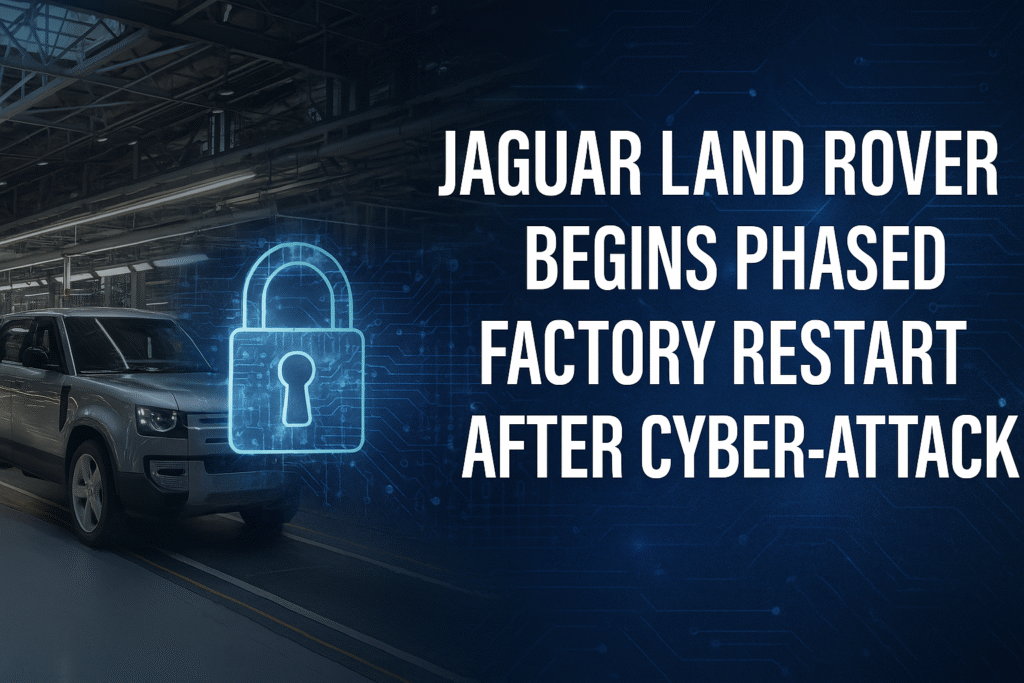
After weeks of silence and shutdowns, Jaguar Land Rover (JLR) has officially started bringing its manufacturing plants back online. The move follows a major cyber-attack that halted production, disrupted IT systems, and exposed just how vulnerable modern car manufacturing has become in the digital age.
The company is now taking a cautious, step-by-step approach — restarting its engine, battery, and vehicle production facilities under tighter digital controls. The recovery marks the beginning of a new chapter for the UK’s largest carmaker, one that places cybersecurity on the same level as physical production.
1. The Attack That Shook British Manufacturing
1.1 How It Started
In late August 2025, JLR was hit by a sophisticated cyber-attack that forced its IT systems offline across the UK and abroad. Overnight, production ground to a halt, supply-chains were frozen, and thousands of workers were left waiting for updates.
The company quickly shut down operations to isolate the threat, effectively freezing all communications, production tracking, and logistics software. Within hours, JLR’s main plants in Solihull, Halewood, and Wolverhampton were idle.
Read Also This: 🧠 U.S. Tech Giant Invests £3.9 Billion in UK Data Centers to Boost AI and Cloud Infrastructure
1.2 The Immediate Fallout
- Manufacturing stopped completely across multiple UK sites.
- Service departments and dealers were unable to process parts or deliveries.
- Suppliers faced cancelled orders and cash-flow strain as payments and logistics systems went offline.
- Analysts estimated the company lost tens of millions of pounds each week in halted production.
While JLR hasn’t publicly confirmed the source of the breach, cybersecurity experts believe it was a ransomware-style attack targeting corporate networks and operational technology.
2. A Controlled Restart: Factory by Factory
2.1 The Recovery Timeline
After five weeks of downtime, JLR began a phased restart in early October 2025. The process started cautiously to ensure network safety and system integrity before any mass production resumed.
- Wolverhampton Engine Manufacturing Centre: Among the first to restart, focusing on critical powertrain production.
- Battery Assembly Centre (Hams Hall/Coleshill): Restarted shortly after to support upcoming electric vehicle models.
- Solihull & Halewood Plants: Gradual reactivation of body shops and stamping operations for Range Rover and Defender models.
- Castle Bromwich Plant: Restarted select operations supporting components and tooling.
Each restart stage required extensive digital system checks, ensuring equipment could safely reconnect to JLR’s restored IT infrastructure.
2.2 Support for Suppliers
Recognising the impact on its supply network, JLR rolled out emergency measures:
- A supplier support fund offering early payments to small and medium partners.
- Temporary loan facilities guaranteed by the UK government to stabilise the automotive supply chain.
- A dedicated “restart taskforce” to help suppliers restore production and digital communication systems.
By mid-October, all major JLR plants had resumed partial production — though at reduced output as systems were tested and staff retrained on updated security protocols.
3. Economic and Operational Impact
3.1 Financial Losses
The cyber-attack caused one of the biggest production halts in JLR’s history. The company’s third-quarter output dropped nearly 20 percent, delaying deliveries and cutting into global sales momentum.
Insiders estimated the total disruption cost at hundreds of millions of pounds, factoring in idle labor, supply-chain penalties, and recovery expenses.
3.2 Supplier Strain
Thousands of smaller UK businesses — from electronics manufacturers to logistics firms — rely on JLR’s production cycle. When orders stopped, their revenues collapsed overnight.
To prevent cascading failures, the UK government offered a £1.5 billion loan guarantee, ensuring suppliers could keep operations running while JLR rebuilt its network.
3.3 Lessons for Industry
The incident is a wake-up call for the wider automotive sector. As car factories rely more on connected software, automation, and digital twins, cyber resilience has become just as critical as physical safety.
This event proves that one digital breach can shut down thousands of physical machines across multiple sites — blurring the line between IT and manufacturing risk.
4. The Path to Full Recovery
4.1 Remaining Challenges
- Incomplete Production: Some assembly lines still operate below normal levels while systems are validated.
- Cybersecurity Hardening: JLR is implementing a zero-trust digital security model and rebuilding parts of its network architecture.
- Data Uncertainty: Forensic teams are investigating whether sensitive design or supplier data was accessed.
- Employee Retraining: Staff are being trained to spot phishing and digital risks — a new kind of “factory safety.”
4.2 A New Era of Security
The company has hired several global cybersecurity firms to establish a 24/7 monitoring network. It’s also investing in AI-driven threat detection, ensuring that production systems can continue safely even during potential future attacks.
Experts believe this incident could make JLR one of the most cyber-resilient automakers in the world — provided it learns fast and embeds cybersecurity deep into its production DNA.
5. Broader Implications for the UK Automotive Industry
Strengthening National Resilience
The attack exposed how dependent the UK’s industrial economy has become on a few major manufacturers. When JLR stopped, thousands of jobs and billions in GDP output were at stake.
In response, the Department for Business and Trade is reportedly drafting new Cyber Safety Standards for Industry, aiming to enforce tougher security audits across manufacturing sectors.
A Push Toward Digital Sovereignty
There’s also a growing movement for automakers to use domestic data centres and cloud infrastructure, reducing exposure to international cyber threats.
The lesson is clear: connected factories need fortress-level security, not just efficiency.
6. Looking Ahead
Jaguar Land Rover expects full production to resume before the end of 2025, with new safety layers protecting every digital and mechanical process.
The company’s new strategy focuses on:
- Reinforcing data security across every system.
- Diversifying suppliers to avoid single points of failure.
- Integrating AI monitoring tools for predictive cybersecurity.
- Communicating transparently with customers, employees, and investors.
If executed successfully, this crisis could transform JLR from a victim of cyber disruption into a case study for industrial resilience.
Conclusion
Jaguar Land Rover’s phased recovery after its massive cyber-attack represents both a challenge and an opportunity. The company’s methodical restart demonstrates caution and accountability — but also highlights the fragile intersection of technology and manufacturing.
As digital systems become the lifeblood of modern production, the automaker’s experience is a warning for the entire industry: cybersecurity is no longer just an IT issue — it’s a core pillar of business continuity.
For JLR, the road to recovery will test its ability to adapt, rebuild trust, and prove that even after the biggest breakdowns, innovation can drive resilience.
Frequently Asked Questions (FAQ)
Q1. When did the cyber-attack on JLR occur?
The attack happened in late August 2025, forcing the company to halt production across all major UK factories.
Q2. How long were factories shut down?
Operations were suspended for about five weeks before a phased restart began in early October.
Q3. Which plants restarted first?
The Wolverhampton engine facility and Hams Hall battery centre were among the first, followed by Solihull and Halewood assembly plants.
Q4. What caused the disruption?
JLR hasn’t confirmed details, but cybersecurity analysts believe it was a ransomware-type attack targeting internal systems and networks.
Q5. Is production fully back to normal?
Not yet — while all factories have reopened, production levels remain below normal as security systems and supply chains are fully restored.

Azeem Aosaf is a visionary entrepreneur, digital strategist, and educator with a mission to empower individuals through online earning and digital innovation. As the CEO of HelixNex LLC, he leads multiple ventures across e-commerce, education, and fintech—helping people turn their digital skills into sustainable income. Through his educational initiative RankTrak, Azeem has trained hundreds of students in SEO, YouTube Automation, Freelancing, and AI-powered marketing. His work bridges technology and opportunity—creating a platform where learning meets real-world success. When he’s not mentoring students or building digital products, Azeem shares insights on entrepreneurship, marketing trends, and financial freedom through his blogs and social platforms. His core belief: “Your Growth, Our Mission.”