Introduction
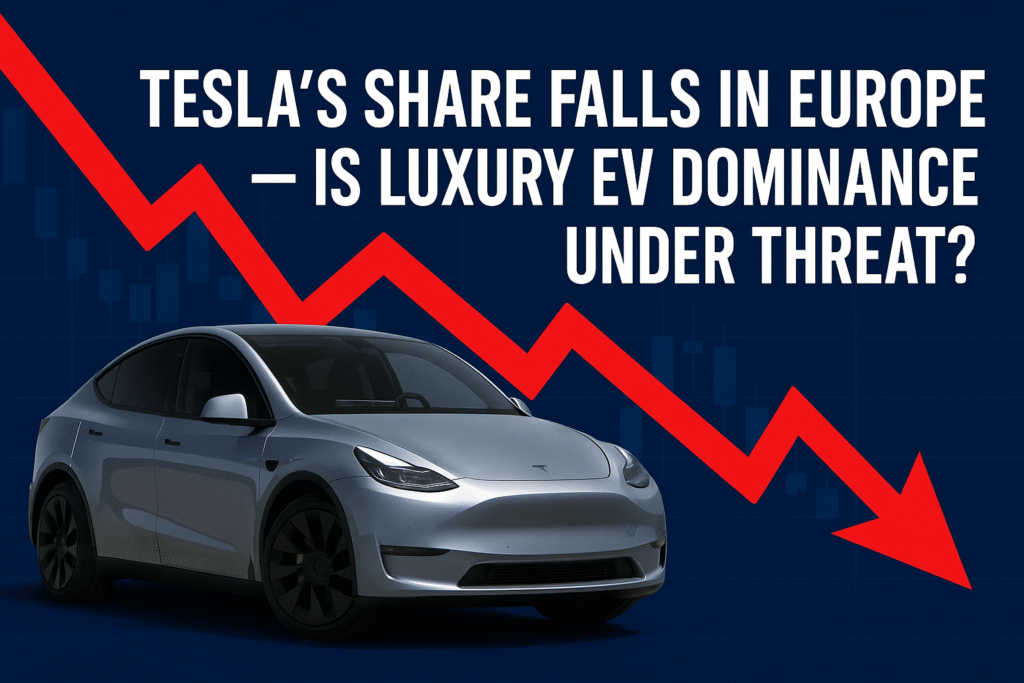
Once seen as the unrivaled king of electric vehicles, Tesla is now losing its grip on the European EV throne. Despite record-breaking demand for electric cars across the continent, the American automaker’s market share has been steadily sliding in 2025, raising a critical question:
👉 Is Tesla’s dominance in the luxury EV market finally under threat?
This story goes beyond Tesla — it’s about the new power balance in Europe’s booming EV industry, where rivals from Germany to China are racing to claim a slice of the premium market once ruled by Elon Musk’s company.
Tesla’s Market Share Takes a Sharp Turn
The data coming out of Europe paints a concerning picture for Tesla’s performance this year:
- Tesla’s European sales have dropped by nearly half compared to 2024, despite overall EV sales across the EU, UK, and EFTA regions rising by more than 30%.
- The company’s market share slipped below 3%, marking its weakest position in years.
- Meanwhile, Chinese automakers like BYD and European luxury brands like Mercedes, Audi, and BMW are seeing major gains.
This isn’t just a one-month blip — it’s a structural shift. Tesla’s stronghold in Europe’s luxury EV segment is clearly eroding as competition surges and buyers become more selective.
Read Also This: Jaguar Land Rover Cyber Attack Slashes UK Car Production — Industry Faces Digital Crisis
Why Tesla Is Losing Ground in Europe
Tesla’s struggle in Europe can be traced to a mix of strategic, competitive, and cultural challenges that have caught up with the once-dominant EV pioneer.
1. Intense Competition from China and Europe
- Chinese brands like BYD, NIO, and XPeng are offering high-tech, stylish EVs at lower prices, shaking up the mid-to-premium market.
- European automakers — once lagging in electrification — have rapidly expanded their EV lineups, combining luxury interiors with cutting-edge battery tech.
- Tesla, by contrast, is relying heavily on its older Model 3 and Model Y platforms, which are beginning to feel dated to luxury buyers.
2. Lack of Model Refresh and Design Variety
- European consumers, especially in the premium segment, expect constant innovation and refinement.
- Tesla hasn’t launched a truly new model in Europe for years, and its minimalist design language, once revolutionary, is now seen by some as too plain or repetitive.
- Without fresh offerings, many buyers are shifting toward newer luxury EVs that feel more distinctive and tailored to European tastes.
3. Brand Perception and Cultural Disconnect
- Tesla’s service network issues in certain European countries have dented customer satisfaction.
- Local automakers like BMW and Audi often score higher in brand loyalty, after-sales service, and craftsmanship — areas Tesla has yet to master in Europe.
- Meanwhile, Elon Musk’s global controversies sometimes spill into consumer perception, making traditional luxury buyers hesitant.
4. Pricing Pressure and Value Gaps
- As more brands enter the market, price wars have intensified.
- Tesla’s once-premium image is being challenged by brands offering similar performance at lower prices — and in some cases, more luxury.
- The result: Tesla’s “value advantage” is fading fast.
What This Means for the Luxury EV Segment
Tesla’s decline isn’t a sign of the EV market slowing down — it’s proof that the luxury EV battlefield is heating up.
The End of the First-Mover Advantage
Tesla’s early success came from being a trailblazer. But as the technology gap narrows, first-mover status is no longer enough. Legacy automakers now match or exceed Tesla’s build quality and driving experience.
Luxury EV Buyers Want More Than Tech
Modern premium EV customers care about design, comfort, and craftsmanship as much as acceleration and autonomy. Tesla’s minimalist interiors, once futuristic, now face tough competition from brands delivering true luxury experiences inside the cabin.
Europe Sets a Global Tone
Europe’s EV market is among the most mature in the world. Trends here often predict what happens next in North America. Tesla’s European struggles could signal a broader shift in global luxury EV demand — where exclusivity and emotional appeal matter more than raw performance metrics.
Tesla’s Possible Comeback Strategy
Despite the headwinds, Tesla is far from finished. The company still has one of the strongest EV infrastructures, a powerful global brand, and unmatched software capabilities. But to regain its footing in Europe, it must evolve.
1. Refresh and Localize Models
Tesla needs new designs tailored for European buyers, focusing on compact luxury EVs, refined interiors, and diverse trims.
Localized production could also cut costs and boost appeal by emphasizing “Made in Europe” branding.
2. Rebuild Brand Trust
Improving after-sales service, faster maintenance turnaround, and stronger customer engagement are essential. Luxury buyers expect top-tier support — not just high-tech dashboards.
3. Compete on Experience, Not Just Specs
Tesla’s future strength may lie in software-driven experiences — seamless charging, advanced AI assistants, superior autopilot — combined with luxury refinement.
To stay premium, Tesla must marry innovation with emotional appeal.
The Broader Impact: A New Era for EV Competition
The luxury EV segment is now anyone’s game. Tesla’s decline opens doors for dozens of players ready to define what “premium electric” means next.
- Mercedes-Benz EQ series, Audi e-tron, and BMW i-series are expanding aggressively.
- Porsche Taycan continues to dominate the high-performance niche.
- Chinese newcomers are flooding Europe with competitively priced, tech-heavy EVs that feel premium.
In other words: the EV market isn’t shrinking — it’s evolving into a true multi-brand ecosystem where buyers have more choice, and brand loyalty is up for grabs.
Implications for the UK, US, and Canada
- UK: Tesla’s sales slump could push British buyers toward homegrown or European luxury EVs. Expect more competition and potential discounts in the coming months.
- US: Tesla’s European decline may trigger a renewed push for innovation and affordability in its home market to defend global leadership.
- Canada: As a bridge between the U.S. and Europe, Canada’s luxury EV buyers will likely see better deals, more imports, and broader brand variety as competition heats up globally.
Conclusion
Tesla’s fall in European market share marks a turning point for the global EV landscape. The once-untouchable pioneer is now facing its toughest challenge yet — a wave of hungry rivals that combine technology with traditional luxury appeal.
While Tesla remains a powerhouse in software, battery tech, and brand recognition, its dominance in the premium EV segment is no longer guaranteed.
The future will belong to companies that can deliver innovation, design, and emotional connection — not just electric motors and range numbers.
As the EV revolution enters its next phase, Tesla must do what it does best: disrupt again — or risk being disrupted.
Frequently Asked Questions (FAQ)
Q1. Why are Tesla’s sales dropping in Europe?
Due to tougher competition, lack of new models, and changing consumer tastes toward more luxurious, regionally tuned EVs.
Q2. Which brands are benefiting from Tesla’s decline?
Mercedes, BMW, Audi, Porsche, and Chinese brands like BYD and NIO are rapidly capturing Tesla’s lost market share.
Q3. Does this mean Tesla is losing its global dominance?
Not yet. Tesla remains strong in the U.S. and Asia, but Europe’s trends suggest it must innovate faster to stay ahead.
Q4. Could lower prices help Tesla recover?
Possibly, but luxury buyers often value design and prestige more than price. A refreshed design and enhanced quality may work better.
Q5. What’s next for Tesla in Europe?
Expect new localized models, better after-sales service, and aggressive marketing campaigns aimed at reclaiming premium customers.

Azeem Aosaf is a visionary entrepreneur, digital strategist, and educator with a mission to empower individuals through online earning and digital innovation. As the CEO of HelixNex LLC, he leads multiple ventures across e-commerce, education, and fintech—helping people turn their digital skills into sustainable income. Through his educational initiative RankTrak, Azeem has trained hundreds of students in SEO, YouTube Automation, Freelancing, and AI-powered marketing. His work bridges technology and opportunity—creating a platform where learning meets real-world success. When he’s not mentoring students or building digital products, Azeem shares insights on entrepreneurship, marketing trends, and financial freedom through his blogs and social platforms. His core belief: “Your Growth, Our Mission.”