💻 How the Jaguar Land Rover Cyber Attack Unfolded
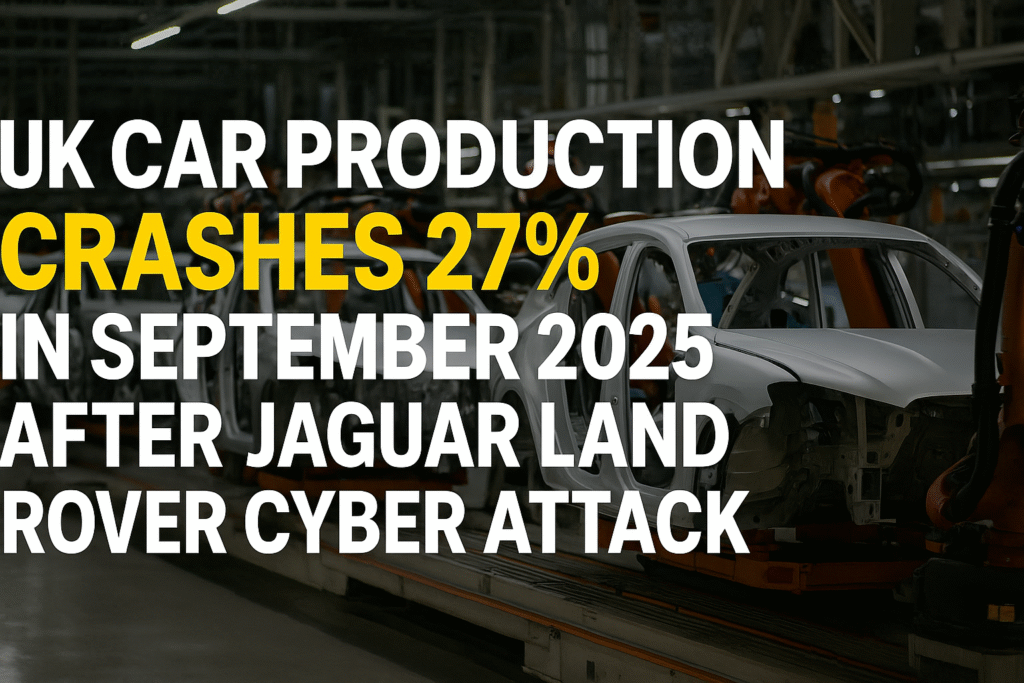
The cyber incident, first detected in late August 2025, forced JLR to suspend operations at several major facilities, including its Solihull, Halewood, and Wolverhampton plants. The company’s internal IT infrastructure was reportedly compromised, leaving manufacturing systems offline for more than five weeks.
As a result, no vehicles rolled off JLR’s production lines during that time. For a company that typically manufactures hundreds of cars daily, the impact was immediate and severe.
Industry insiders estimate the disruption cost the UK economy nearly £2 billion, as suppliers, logistics firms, and component manufacturers all suffered cascading losses.
🏭 Why the Decline Was So Severe
Several interconnected factors deepened the September slump beyond the direct impact on JLR:
1. JLR’s Dominant Market Share
Jaguar Land Rover is the UK’s largest car producer. When its plants went dark, the national production tally nosedived. While other manufacturers like Nissan, Toyota, and Mini maintained output, they couldn’t make up for JLR’s losses.
Read Also This: 🚗 Why Europe’s New-Car Boom Doesn’t Mean the EV Revolution Has Arrived
2. Export Setbacks
The cyber-attack halted shipments bound for Europe, the US, and China. Exports reportedly fell by nearly a quarter as order backlogs grew and deliveries were delayed.
3. Commercial Vehicle Decline
Not just cars — van and truck production also dropped sharply, with industry estimates showing declines of 70% or more in some segments.
4. Supply-Chain Shockwaves
Dozens of smaller component makers were forced to cut shifts or halt production entirely due to missing orders from JLR. The interconnected nature of the automotive supply chain magnified the fallout.
5. Digital Dependency
Modern car manufacturing relies heavily on networked systems and automation. Once the digital backbone was compromised, even unaffected plants faced indirect slowdowns due to lost communication and logistics coordination.
⚙️ A Cyber Wake-Up Call for UK Manufacturing
This event served as a reality check for Britain’s industrial resilience. It revealed just how vulnerable the country’s manufacturing infrastructure has become to digital threats.
In an era when factories are integrated through smart systems and connected software, a single security breach can halt national output overnight. The JLR attack wasn’t just a disruption — it was a warning.
Experts now urge manufacturers to:
- Strengthen cybersecurity frameworks and invest in 24/7 network monitoring
- Create redundant systems to maintain production continuity during cyber crises
- Train employees to recognize phishing and ransomware threats
- Develop government-backed cyber-defense partnerships to protect critical manufacturing sectors
📉 Economic and Employment Fallout
The effects of September’s production collapse extend well beyond factory gates.
- Job Security: Around 60,000 jobs connected to the automotive industry could face temporary or long-term risk if recovery lags.
- Supplier Strain: Small and medium suppliers reliant on JLR contracts faced cash-flow crises and operational downtime.
- Revenue Hit: Reduced production means lower exports, less VAT revenue, and declining manufacturing output for the UK’s GDP.
- Price Pressure: Consumers may soon face longer wait times and rising car prices due to constrained supply and increased demand for imported vehicles.
⚡ Electric and Hybrid Vehicles Remain a Bright Spot
Despite the slump, one encouraging detail emerged: nearly half of all UK-built vehicles in September were either electric or hybrid models.
This indicates that even amid turmoil, automakers remain committed to the EV transition, aligning with the UK’s goal of becoming a global hub for green mobility. However, the JLR hack also shows that digital innovation must be matched by digital protection — as more EV plants adopt AI-driven automation and connected production tools.
🔄 Recovery Timeline: What’s Next?
✅ Gradual Restart
By mid-October 2025, JLR began a phased restart of its production lines. However, full capacity is expected to resume only by early 2026, as the company rebuilds its digital systems and reassesses cybersecurity protocols.
💰 Industry Support Measures
Trade groups have urged the government to offer temporary relief — such as energy cost caps, digital defense grants, and tax incentives for cybersecurity investments — to help factories recover.
🌍 Global Repercussions
The UK’s vehicle output drop also affects international supply chains. Some European dealers reported delays in Land Rover and Range Rover deliveries, while global investors began questioning the resilience of UK manufacturing.
🧩 Reputation & Resilience
Rebuilding trust will take time. JLR must prove that it can safeguard both customer data and manufacturing systems from future cyber incidents. The government, meanwhile, is expected to introduce stricter industrial cyber-protection regulations in the coming months.
🏎️ How the Industry Can Rebound Stronger
- Invest in Cyber-Resilient Infrastructure:
Building secure, segmented networks that can isolate breaches without halting operations. - Diversify Production Sites:
Encouraging distributed manufacturing across multiple regions to avoid single-point dependency. - Encourage Collaboration:
Public-private partnerships between automakers, cybersecurity experts, and government agencies to share intelligence. - Digital Workforce Upskilling:
Introducing cybersecurity training for plant operators and engineers to prevent insider threats or accidental breaches. - Sustainable Modernization:
Aligning EV growth and Industry 4.0 innovation with a strong cyber backbone to future-proof production.
💬 Why This Matters to You
- Consumers: Expect possible price hikes or delays for new vehicles — especially luxury SUVs and electric models made in the UK.
- Investors: The attack highlights risks tied to digital dependence and may influence stock valuations across the automotive sector.
- Policy-Makers: The event underscores the urgency of implementing stronger digital infrastructure for critical manufacturing.
- Suppliers: It’s a call to diversify clients and build backup contracts to survive production halts.
- Tech Professionals: A reminder that cybersecurity is now just as vital as mechanical engineering in the automotive world.
❓ Frequently Asked Questions (FAQ)
Q1. How much did UK car production drop in September 2025?
A1. Vehicle production in the UK fell by around 27% compared to the same period last year — one of the sharpest declines in recent history.
Q2. What caused the decline?
A2. A massive cyber-attack on Jaguar Land Rover crippled several of its UK plants for over a month, slashing national output.
Q3. How long will recovery take?
A3. Production is gradually resuming, but full output isn’t expected until early 2026 as systems are rebuilt and secured.
Q4. Did the attack affect electric vehicles too?
A4. Yes — though EV production held relatively steady, it was still impacted by supply and logistics slowdowns.
Q5. What lessons can other manufacturers learn?
A5. Prioritize cyber resilience, maintain redundant systems, and ensure employee cyber-awareness training to prevent similar large-scale shutdowns.
📰 Final Thoughts
The September 2025 plunge in UK vehicle production is more than a temporary hiccup — it’s a national wake-up call. A single cyber-attack on Jaguar Land Rover exposed deep weaknesses in the digital backbone of the country’s manufacturing sector.
If the UK wants to remain a competitive automotive hub in the era of electrification and automation, it must treat cybersecurity as core infrastructure, not an afterthought.
The road to recovery will be long, but with the right investments, policies, and digital safeguards, Britain’s auto industry can steer back toward stability — stronger, smarter, and far more resilient than before.

Azeem Aosaf is a visionary entrepreneur, digital strategist, and educator with a mission to empower individuals through online earning and digital innovation. As the CEO of HelixNex LLC, he leads multiple ventures across e-commerce, education, and fintech—helping people turn their digital skills into sustainable income. Through his educational initiative RankTrak, Azeem has trained hundreds of students in SEO, YouTube Automation, Freelancing, and AI-powered marketing. His work bridges technology and opportunity—creating a platform where learning meets real-world success. When he’s not mentoring students or building digital products, Azeem shares insights on entrepreneurship, marketing trends, and financial freedom through his blogs and social platforms. His core belief: “Your Growth, Our Mission.”