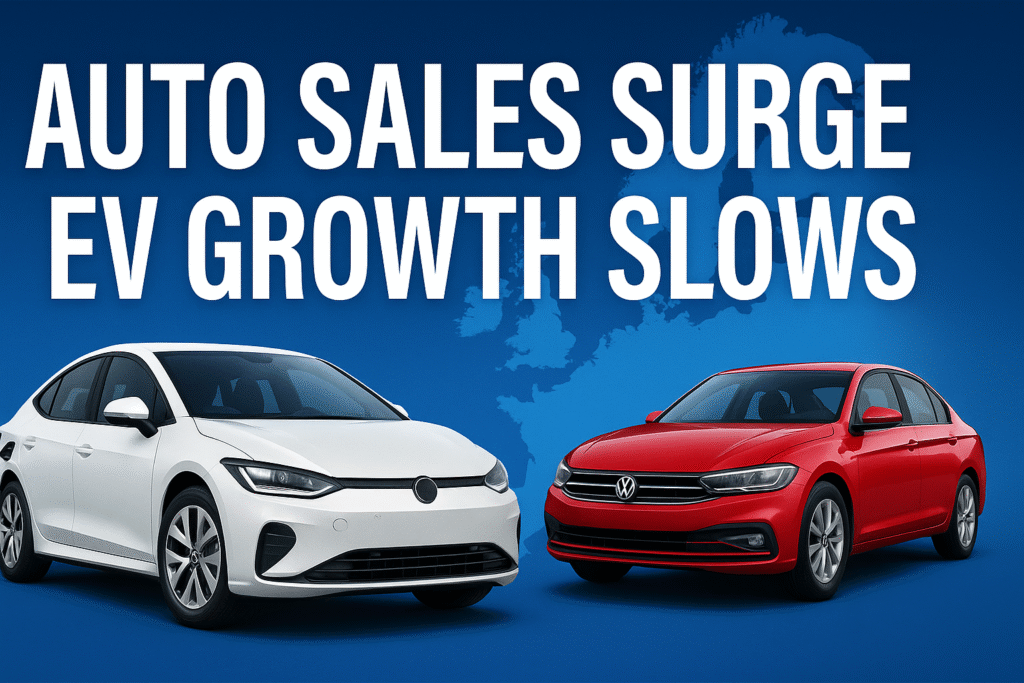
After several years of turbulence, Europe’s car industry is accelerating once again. Dealerships are reporting stronger demand, manufacturing output is rising, and overall vehicle registrations are trending upward across major EU markets.
But beneath the surface of this rebound lies a crucial truth: the electric revolution is slowing down. While new car sales are climbing, electric vehicle (EV) adoption isn’t keeping pace with expectations.
📈 Europe’s Car Sales Are Back on Track
Throughout 2025, Europe’s automotive sector has experienced its strongest performance since the pandemic era. Manufacturers are finally overcoming supply-chain bottlenecks, semiconductor shortages, and logistics issues that once crippled production.
- New car registrations across the EU have increased steadily in 2025, marking a clear recovery compared to the previous year.
- Hybrid and plug-in hybrid models have seen the sharpest growth, appealing to consumers seeking fuel efficiency without full EV commitment.
- Fleet sales—especially among rental and business customers—have surged as companies renew their inventories after years of postponement.
In short, the European car market is roaring back to life. But EVs are still struggling to win over the average driver.
Read Also This: Tesla’s Share Falls in Europe — Is Luxury EV Dominance Under Threat?
⚡ EV Adoption: Growth Slows Despite Awareness Boom
Even with rising environmental awareness and stronger government incentives, full-electric vehicles (BEVs) continue to face challenges.
Across Europe, EVs currently represent around 16–18% of all new car sales, which is an improvement from 2024 but far from the rapid growth analysts predicted.
Key reasons for the slowdown:
- High upfront costs – Even as prices fall, EVs remain significantly more expensive than petrol or hybrid vehicles.
- Inconsistent charging infrastructure – Rural and small-town regions across Europe still lack fast-charging networks.
- Shrinking subsidies – Several governments, including Germany and France, have scaled back EV purchase incentives.
- Range anxiety – Many drivers remain concerned about long-distance travel limitations and charging delays.
- Hybrid preference – Consumers view plug-in hybrids as a safer “middle ground” until EV technology matures further.
🏭 Why Traditional Car Sales Are Surging
The comeback in petrol, diesel, and hybrid sales isn’t just a temporary rebound — it reflects deeper market realities.
🔹 Economic Confidence Returns
European economies have stabilized after years of inflationary pressure. Consumer confidence is rising, encouraging big-ticket purchases like new cars.
🔹 Flexible Financing and Leasing
Automakers and dealers are offering attractive financing plans, making conventional cars more accessible than before.
🔹 Diverse Model Options
Many brands have expanded their hybrid and fuel-efficient lineups, offering appealing alternatives for consumers not ready to go fully electric.
🔹 Supply Chain Recovery
Production lines are back at full capacity, meaning shorter waiting times and more vehicles available on showroom floors.
🌍 The Regional Divide: Europe’s Uneven EV Progress
EV adoption isn’t uniform across Europe — it’s a tale of two markets.
- Northern and Western Europe (especially Norway, the Netherlands, and Germany) continue leading the charge, supported by better infrastructure and government backing.
- Southern and Eastern Europe lag behind due to slower infrastructure rollout, lower income levels, and fewer incentives.
This uneven progress risks creating a two-speed automotive transition, where wealthier nations electrify faster while others remain reliant on combustion engines for years to come.
💡 Automakers Are Rethinking Their EV Strategy
Europe’s biggest carmakers—Volkswagen, Stellantis, Renault, and BMW—are now recalibrating their electrification timelines.
Instead of pushing for an all-electric lineup immediately, many are opting for a dual-track strategy:
- Continue producing internal combustion and hybrid models to meet short-term demand.
- Gradually scale EV investments as charging infrastructure improves and production costs fall.
Meanwhile, Chinese EV manufacturers such as BYD and NIO are expanding aggressively in Europe, offering cheaper models that could disrupt traditional players if affordability remains an issue.
⚠️ Challenges That Could Stall EV Momentum
Despite strong policy commitments, Europe’s EV journey faces real-world headwinds:
- Charging Speed and Access: Many countries lack nationwide coverage of rapid-charging stations.
- Battery Costs: Raw material prices (lithium, cobalt) continue to fluctuate, affecting vehicle affordability.
- Consumer Skepticism: Drivers still doubt long-term battery reliability and resale value.
- Energy Grid Stress: A growing EV fleet will demand heavy investment in clean power and smart-grid systems.
- Policy Uncertainty: Sudden subsidy cuts or changing tax rules discourage long-term consumer trust.
🚀 What Lies Ahead for the European Auto Market
Despite short-term setbacks, experts predict the EV transition will accelerate again once infrastructure, affordability, and consumer confidence align.
Between 2026 and 2030, analysts expect:
- EVs to surpass 30% of new vehicle sales across Europe.
- Mass-market brands to introduce sub-£25,000 EV models.
- Governments to launch charging infrastructure partnerships with private companies.
- More stringent emission regulations to push automakers toward electrification.
Europe’s road to full electrification might be slower than expected—but it’s still inevitable.
🧩 Key Takeaways
✅ Auto sales are recovering fast, driven by pent-up demand and economic stability.
⚡ EV growth continues but at a slower pace, hindered by cost and infrastructure gaps.
🌍 Northern Europe leads, while southern and eastern regions still trail.
🚗 Hybrids dominate short-term growth, bridging the gap between combustion and full-electric vehicles.
🔋 The long game remains electric, as affordability and accessibility gradually improve.
💬 Final Thoughts
Europe’s car market has regained its momentum — but the electric dream is still in the slow lane.
The transition is happening, yet challenges around infrastructure, affordability, and public trust are slowing its speed.
Still, the direction is clear: as technology improves and economies adapt, electric vehicles will eventually take the driver’s seat in Europe’s automotive future.
❓ Frequently Asked Questions (FAQ)
Q1. Why are overall car sales rising in Europe in 2025?
A1. Stronger supply chains, pent-up consumer demand, and more financing options have boosted new car registrations across the continent.
Q2. Why is electric vehicle adoption slower than expected?
A2. High upfront prices, limited charging networks, and reduced subsidies are major obstacles for many buyers.
Q3. Which countries lead EV adoption in Europe?
A3. Norway, Germany, and the Netherlands lead due to stronger policy support and better charging infrastructure.
Q4. Are hybrids competing with EVs?
A4. Yes — hybrids have become the go-to option for consumers who want lower emissions without full-electric limitations.
Q5. When will EVs dominate European car sales?
A5. Experts project that by 2030, EVs could make up around 50% of new vehicle sales, provided governments maintain infrastructure and incentives.

Azeem Aosaf is a visionary entrepreneur, digital strategist, and educator with a mission to empower individuals through online earning and digital innovation. As the CEO of HelixNex LLC, he leads multiple ventures across e-commerce, education, and fintech—helping people turn their digital skills into sustainable income. Through his educational initiative RankTrak, Azeem has trained hundreds of students in SEO, YouTube Automation, Freelancing, and AI-powered marketing. His work bridges technology and opportunity—creating a platform where learning meets real-world success. When he’s not mentoring students or building digital products, Azeem shares insights on entrepreneurship, marketing trends, and financial freedom through his blogs and social platforms. His core belief: “Your Growth, Our Mission.”