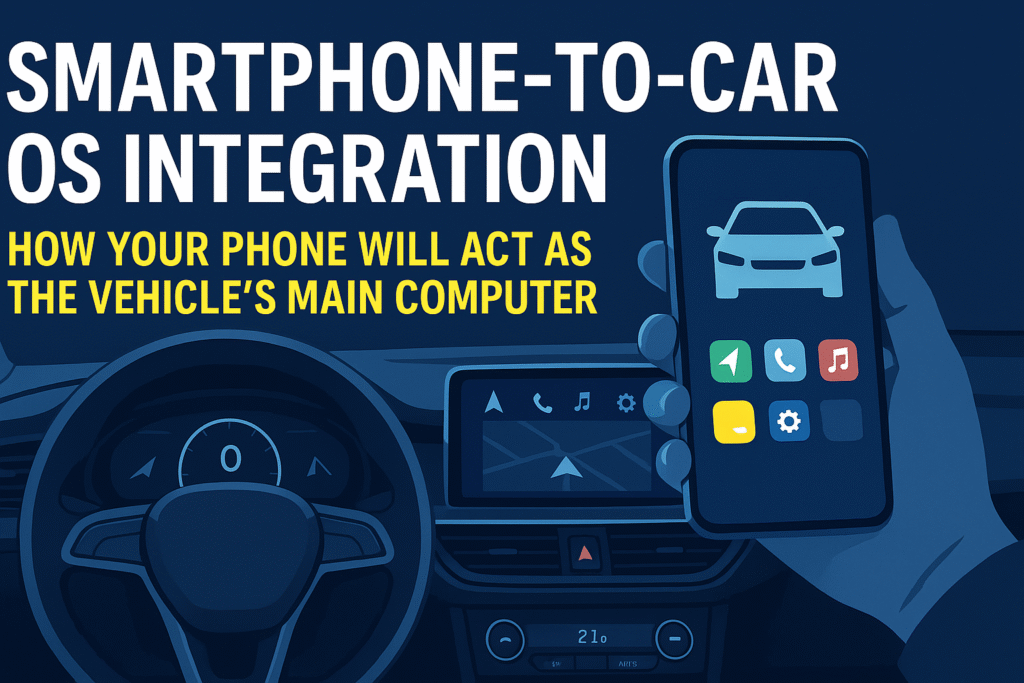
The line between your smartphone and your car is blurring faster than ever. Within the next few years, your phone won’t just connect to your car — it will run it.
From unlocking the doors and setting navigation routes to managing energy use and system updates, the phone is poised to become the vehicle’s central computer. The era of true smartphone-powered driving has begun.
⚙️ 1. The Evolution of Car-Phone Integration
1.1 From CarPlay to Control
We’ve already seen the early steps: Apple CarPlay, Android Auto, and Android Automotive OS allow apps to run directly on the car’s infotainment screen. Drivers can control maps, calls, and entertainment — but the systems still depend on the car’s onboard computer.
The next generation goes beyond projection. Automakers are now designing vehicles where the smartphone’s operating system manages most digital functions, turning your device into the core processor of the car’s ecosystem.
Read Also This: 🚗 EV Revolution 2025: New Car Launches, Strategy Shake-Ups & Supply Chain Overhaul
1.2 What’s Changing
- Cloud-synced personalization – Your seat position, mirrors, preferred radio stations, and climate settings are stored in your phone profile.
- Remote operations – Start, lock, and monitor your vehicle directly from your phone’s OS.
- Vehicle health analytics – Your phone becomes a diagnostic hub, monitoring performance, battery, and maintenance.
In essence, the smartphone becomes an extension of the car — and the car becomes an extension of you.
🔋 2. How the Technology Works
2.1 The Connection Layer
Future vehicles will run a lightweight operating system designed to communicate directly with smartphones. Think of it like plugging your brain into your body — the car provides hardware (wheels, sensors, cameras), while your phone supplies the “mind” that controls them.
Wireless protocols such as 5G, Wi-Fi 6E, and Ultra-Wideband (UWB) allow for instant, secure connections without cables.
2.2 Digital Key & Identity
Apple, Google, and Samsung are leading the rollout of digital car keys, allowing you to unlock, start, and even share your vehicle securely via your phone. This technology uses encrypted NFC and Bluetooth LE signals that verify your identity automatically when you approach the car.
2.3 The OS Ecosystem
- Android Automotive – Integrated directly into vehicles from Volvo, Polestar, GM, and more, this OS lets your phone act as a dynamic interface for updates and app syncing.
- Apple CarPlay Next (2025 update) – Apple’s expanded platform aims to control instrument clusters, speedometers, and HVAC systems through the iPhone, creating a unified Apple-style dashboard experience.
- Proprietary EV ecosystems – Tesla and Rivian are building hybrid systems that combine in-car computers with smartphone-driven updates and voice assistants.
🌐 3. The Benefits of Turning Your Phone Into a Car Computer
3.1 Unified Experience
No more juggling multiple apps or interfaces. Your phone already knows your habits — from your favorite podcasts to your morning commute. When it becomes the vehicle’s core brain, everything syncs automatically.
3.2 Faster Innovation
Instead of waiting years for a software update from your car manufacturer, new features can roll out via phone OS updates. This means faster upgrades and smarter features every year — just like your phone.
3.3 Lower Costs for Automakers
Carmakers can focus on building great vehicles instead of maintaining complex infotainment systems. Offloading computing to smartphones cuts production costs and simplifies maintenance.
3.4 Personalized Mobility
When your phone runs the show, your preferences follow you — whether you’re driving your own car, renting, or using a shared vehicle.
🚧 4. The Challenges Ahead
4.1 Security Risks
As vehicles rely more on connected devices, cybersecurity becomes paramount. Automakers and OS developers must ensure encrypted, tamper-proof communication between phone and vehicle systems.
4.2 Compatibility and Fragmentation
Different automakers use different standards. Ensuring your phone works seamlessly across multiple brands — without losing features — remains a major challenge.
4.3 Dependency on Smartphones
If your phone battery dies, or your OS crashes, your car could lose some digital functionality. Backup systems will be essential to prevent lockouts or loss of control.
4.4 Regulatory Hurdles
Governments in the UK, US, and Canada are scrutinizing driver-distraction laws, data privacy, and over-the-air control systems. The more our phones do, the more regulation will follow.
🇬🇧🇺🇸🇨🇦 5. Regional Outlook: UK, US & Canada
United Kingdom
The UK is embracing connected-car legislation with new cybersecurity and privacy standards under the Vehicle Data Access Act. Expect early adoption of Apple and Google ecosystems among premium EVs.
United States
The US leads the integration race, with GM, Ford, and Tesla pushing native phone-driven interfaces. Silicon Valley’s influence ensures that software updates remain fast and frequent.
Canada
Canada’s growing EV market and 5G rollout make it a key testing ground for connected-car innovations. Expect partnerships between telecoms and automakers to accelerate smartphone-OS adoption.
🔮 6. What’s Next: The Road to Full Smartphone Integration
Within five years, analysts expect over 70% of new vehicles to support deep phone-driven OS integration. By 2030, your smartphone could:
- Fully replace the vehicle’s infotainment system
- Manage all vehicle diagnostics and updates
- Handle in-car payments (tolls, charging, parking)
- Provide real-time AI copilots via built-in assistants like Siri, Gemini, or Copilot
This convergence means cars will become software platforms on wheels — and your phone will be the key that powers them.
🏁 Conclusion
The age of smartphone-powered vehicles is upon us. Soon, every driver will carry their car’s digital DNA in their pocket — unlocking, updating, and personalizing their driving experience through a single device.
For automakers, this marks a shift from building cars to building ecosystems. For consumers, it’s a revolution in convenience and control. And for technology itself, it’s one more step toward the fully connected world we’ve been promised for decades.
Your phone won’t just connect to your car anymore. It will be your car.
❓ Frequently Asked Questions (FAQ)
Q1: How is this different from Apple CarPlay or Android Auto?
A1: Those systems mirror your phone’s screen onto the car display. In the new model, your phone’s OS actually controls the car’s functions — from dashboard data to driving preferences.
Q2: Will I still need my car’s built-in system?
A2: Most new vehicles will include lightweight backup software, but the main interface and intelligence will come from your phone.
Q3: Is this safe?
A3: Yes, as long as systems use encrypted communication and secure authentication. Automakers are designing strong safety layers to prevent hacking or data theft.
Q4: When will this technology be common?
A4: Expect widespread rollout between 2026 and 2028, especially in EVs and premium models.
Q5: Can older cars use this technology?
A5: Some aftermarket devices and adapters will enable limited phone integration, but full control will require next-generation vehicles built with this functionality in mind.

Azeem Aosaf is a visionary entrepreneur, digital strategist, and educator with a mission to empower individuals through online earning and digital innovation. As the CEO of HelixNex LLC, he leads multiple ventures across e-commerce, education, and fintech—helping people turn their digital skills into sustainable income. Through his educational initiative RankTrak, Azeem has trained hundreds of students in SEO, YouTube Automation, Freelancing, and AI-powered marketing. His work bridges technology and opportunity—creating a platform where learning meets real-world success. When he’s not mentoring students or building digital products, Azeem shares insights on entrepreneurship, marketing trends, and financial freedom through his blogs and social platforms. His core belief: “Your Growth, Our Mission.”