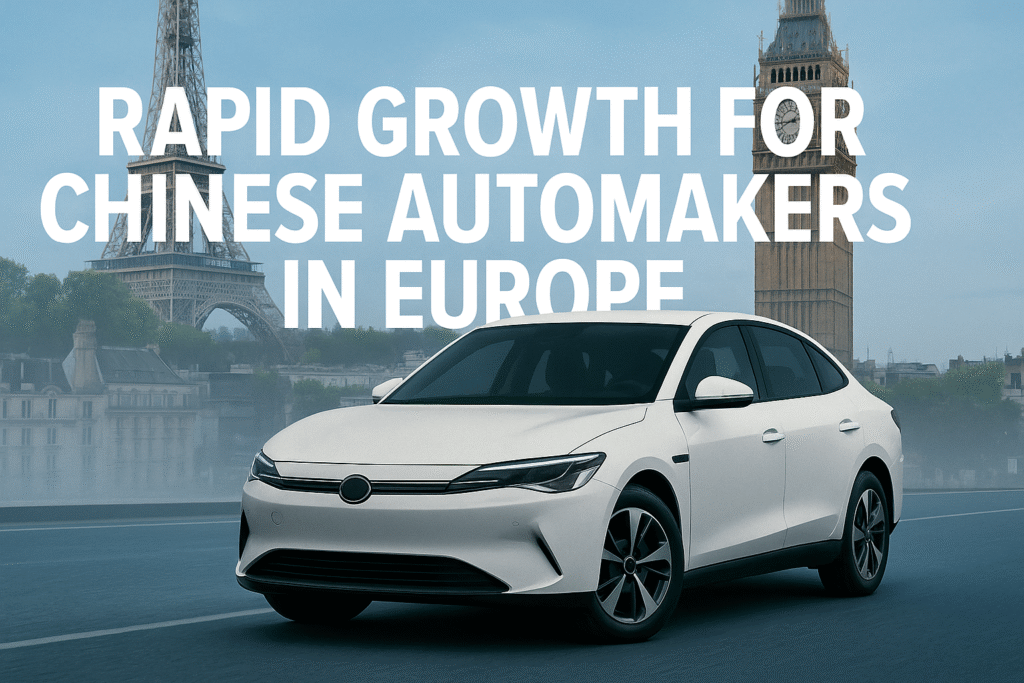
Europe’s automotive landscape is undergoing a seismic shift. Once dominated by German, French, and British marques, the region is now seeing an unprecedented surge of Chinese automakers entering — and thriving — in its markets.
What started as a slow push for recognition just a few years ago has evolved into a full-scale market transformation. Backed by strong technology, competitive pricing, and global ambition, Chinese automakers are now rewriting the rules of the European car industry.
📈 Explosive Growth: The Numbers Tell the Story
In 2025, Chinese automakers have achieved what few thought possible — rapid, double-digit expansion across the continent.
- Chinese carmakers have doubled their market share in Europe within just one year, now holding roughly 5–6% of total car sales.
- Leading brand BYD (Build Your Dreams) has become a household name, with its European deliveries growing fivefold since last year.
- Other Chinese automakers such as XPeng, MG (SAIC-owned), NIO, and Great Wall Motors have launched new models tailored for European tastes and safety standards.
- In markets like Norway, the Netherlands, and the UK, electric and hybrid Chinese vehicles now rival established European and Japanese competitors.
This surge is not a coincidence — it’s a result of strategic long-term planning by Chinese automakers who see Europe as the next major growth frontier.
Read Also This: 💼 Tech Prosperity Deal: How the UK–US £31 Billion Pact Is Reshaping Global Tech
⚙️ Why Chinese Automakers Are Growing So Fast
1. Affordable Electric Vehicles (EVs)
As European car prices rise, Chinese automakers are filling a major gap: affordable, well-equipped EVs.
Brands like BYD and MG offer electric and plug-in hybrid vehicles 20–30% cheaper than comparable European models, without sacrificing quality or range.
2. Tech-Driven Cars With Strong Value
Chinese vehicles are no longer “budget buys” — they’re technology showcases. Many models feature AI-powered infotainment systems, advanced driver-assistance, and premium interiors that appeal to Europe’s tech-savvy buyers.
3. Aggressive Expansion and Local Partnerships
Chinese automakers are expanding through strategic alliances with local dealerships, service networks, and logistics partners.
Some have even announced local manufacturing plans in Europe, helping them bypass import tariffs and reduce shipping delays.
4. Adaptation to European Standards
Unlike earlier attempts, modern Chinese brands are fully compliant with EU safety and emission standards, ensuring seamless entry into the market. Their ability to quickly adapt to regulations gives them a critical edge.
🇪🇺 How Europe Is Reacting
The European automotive establishment — once unchallenged — is now facing its biggest test in decades.
🔹 Pressure on Pricing and Margins
Traditional automakers like Volkswagen, Peugeot, and Renault are being forced to rethink pricing strategies and accelerate their EV rollouts. Consumers are increasingly drawn to competitive Chinese alternatives that offer more range and features for less money.
🔹 Trade and Tariff Tensions
European policymakers have raised concerns about subsidized exports and market saturation. Discussions about higher tariffs on imported Chinese EVs are ongoing, but analysts say that even with added costs, many Chinese brands remain price-competitive.
🔹 Rising Local Competition
Some European automakers are responding by partnering with Chinese battery and tech suppliers, rather than opposing them — a sign that collaboration may be more beneficial than confrontation.
🧭 Key Brands Leading the Charge
🚙 BYD
BYD has become the symbol of China’s automotive rise. Its range of electric sedans and SUVs — from the Dolphin to the Seal — offers high performance, long range, and premium tech at competitive prices.
⚡ XPeng
XPeng focuses on smart, software-centric EVs with self-parking and autonomous driving capabilities, appealing to young professionals across Western Europe.
🧩 MG (SAIC Motor)
Originally a British brand, MG is now Chinese-owned and one of Europe’s fastest-growing EV marques. Its vehicles combine heritage appeal with cutting-edge affordability.
🏎️ NIO and Great Wall Motors
Both companies are building recognition for their design and tech. NIO’s battery-swap technology and Great Wall’s hybrid models show how Chinese automakers are redefining innovation.
📍 Regional Highlights
🇬🇧 United Kingdom
MG and BYD have rapidly expanded in the UK, where consumers are looking for affordable EV alternatives amid rising living costs.
🇩🇪 Germany
China’s EV makers are directly challenging premium players in their own backyard. XPeng’s upcoming sedan is positioned against Tesla and BMW, targeting performance and smart tech buyers.
🇫🇷 France & 🇪🇸 Spain
Compact and affordable Chinese EVs are gaining traction with urban commuters — particularly younger buyers and fleet operators focused on sustainability.
⚠️ Challenges Ahead
While growth is impressive, Chinese automakers face several hurdles:
- Regulatory scrutiny over subsidies and fair trade.
- Brand perception — some European consumers still view Chinese vehicles as “unproven.”
- Logistics and servicing — ensuring reliable after-sales networks remains a key challenge.
- Geopolitical risks, including tariffs or new import restrictions that could slow expansion.
Nevertheless, the industry momentum remains overwhelmingly positive — and the long-term trajectory looks unstoppable.
🔮 The Road Ahead: What’s Next for Europe’s Auto Market
- Chinese EV market share in Europe could surpass 10% by 2027.
- Expect more local factories from brands like BYD and Great Wall to avoid tariffs.
- Software integration and AI features will become the new battleground for brand differentiation.
- Legacy automakers will accelerate partnerships with Chinese battery suppliers to remain competitive.
In short, Europe’s next automotive chapter will be defined by collaboration, competition, and rapid innovation.
💬 Final Thoughts
The surge of Chinese automakers in Europe marks the beginning of a new global auto era — one where affordability, technology, and sustainability outweigh legacy and location.
As consumers embrace new brands, Europe’s car market is becoming more diverse, dynamic, and digital.
The question now isn’t if Chinese automakers will stay — it’s how fast they’ll dominate.
The race for Europe’s roads is officially on — and China’s already a few laps ahead.
❓ Frequently Asked Questions (FAQ)
Q1. Why are Chinese automakers growing so quickly in Europe?
Because they offer affordable, tech-rich EVs that meet local standards and appeal to cost-conscious European buyers.
Q2. Which Chinese brands are leading the market?
BYD, XPeng, MG, and NIO are among the fastest-growing brands across Europe.
Q3. Are these cars built in Europe?
Most are currently imported, but several companies plan to open factories in the UK, Germany, and Hungary by 2026.
Q4. How are European automakers responding?
By cutting prices, speeding up EV production, and forming tech partnerships with Chinese suppliers.
Q5. Will Chinese brands dominate Europe long-term?
If they maintain affordability, quality, and local production, their presence will likely expand significantly through the next decade.

Azeem Aosaf is a visionary entrepreneur, digital strategist, and educator with a mission to empower individuals through online earning and digital innovation. As the CEO of HelixNex LLC, he leads multiple ventures across e-commerce, education, and fintech—helping people turn their digital skills into sustainable income. Through his educational initiative RankTrak, Azeem has trained hundreds of students in SEO, YouTube Automation, Freelancing, and AI-powered marketing. His work bridges technology and opportunity—creating a platform where learning meets real-world success. When he’s not mentoring students or building digital products, Azeem shares insights on entrepreneurship, marketing trends, and financial freedom through his blogs and social platforms. His core belief: “Your Growth, Our Mission.”