The promise of a fully electric future for Europe’s auto industry is hitting a reality check. After years of aggressive investment in electric vehicles (EVs), major European automakers are now scaling back production plans and cutting thousands of jobs.
The culprit? Mixed EV demand — consumers are hesitant, production costs are high, and incentives are fading. This combination has left factories underutilized and forced carmakers to confront a sobering truth: the EV transition is proving far more turbulent than expected.
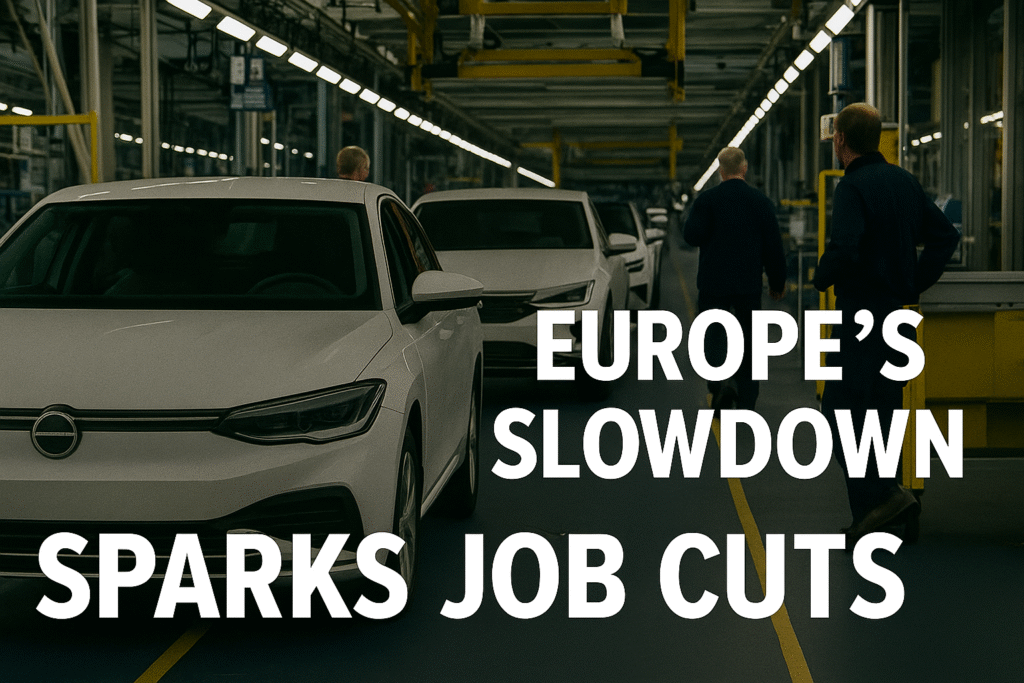
📉 The Wave of Job Cuts Across Europe
Several iconic brands are now tightening their belts and revising their EV strategies:
- Ford Europe has confirmed around 1,000 layoffs at its Cologne plant in Germany, where it had planned to mass-produce electric models for the European market.
- Across the continent, Ford’s broader restructuring plan could see up to 4,000 positions eliminated by 2027, affecting workers in Germany, the UK, and Spain.
- Porsche is reducing nearly 2,000 jobs by 2029, citing slower-than-expected EV adoption and cost pressures.
- Industry suppliers, from battery manufacturers to electronics firms, are quietly trimming staff as production volumes fail to meet early forecasts.
In short, Europe’s automotive workforce is shrinking — and this time, not because of automation, but because the market isn’t evolving fast enough to justify expansion.
Read Also This: 🌍 Rapid Growth for Chinese Automakers in Europe: A Market Transformation in Motion
⚙️ Why EV Demand Is Stalling
The slowdown in Europe’s EV market isn’t about rejection — it’s about hesitation. Let’s break down the main reasons consumers are holding back and manufacturers are feeling the pinch.
1. The End of Generous Incentives
For years, Europe’s EV boom was fueled by government subsidies. But as budgets tighten and priorities shift, many countries — including Germany and the UK — have reduced or ended their EV purchase incentives.
Without those financial boosts, many buyers are returning to hybrid or fuel-efficient petrol models.
2. Charging Anxiety Persists
Europe’s charging network remains uneven. Urban drivers have better access to fast chargers, but rural regions lag behind. For long-distance travelers, charging times and availability remain barriers to full EV adoption.
3. Economic Pressures on Consumers
With inflation still biting and living costs rising, European households are being more cautious about big-ticket purchases. Even as EV prices fall, the upfront cost remains higher than comparable combustion-engine vehicles.
4. Production Costs Are Still High
Automakers are struggling to make EVs profitable. Batteries alone can account for up to 40% of an EV’s cost, and sourcing key materials like lithium and cobalt remains volatile.
Many automakers are losing money on every EV sold — a situation that’s forcing them to pause expansion and restructure operations.
🇩🇪 The German Auto Industry Feels the Heat
Germany, home to automotive giants like Volkswagen, Mercedes-Benz, BMW, and Porsche, is bearing the brunt of the EV slowdown.
- Production forecasts have been downgraded as demand for luxury EVs cools.
- Porsche’s job cuts signal a wider slowdown in premium electric models, which face increasing competition from Chinese brands offering lower-priced alternatives.
- Ford’s Cologne facility, once hailed as the heart of its European EV expansion, is now operating below capacity.
For a nation where nearly one in ten jobs is linked to the automotive sector, these cuts send shockwaves far beyond the factory floor.
🇬🇧 UK Auto Workers Also at Risk
While the UK isn’t seeing the same scale of layoffs — yet — it remains vulnerable. British factories supplying European plants are facing reduced orders, and suppliers fear job losses if demand doesn’t rebound.
Analysts warn that without strong domestic incentives and charging infrastructure, the UK could lag behind continental Europe in EV manufacturing and adoption — undermining its 2035 zero-emission vehicle goals.
⚖️ Balancing Transition and Reality
Automakers are facing a difficult balancing act: they must continue investing in EV technology to meet future emissions goals, while avoiding financial overreach in a market that’s not yet ready to absorb those vehicles.
What’s Changing Inside the Industry
- Companies are reassessing their EV production targets and delaying new launches.
- Many are keeping hybrid models in the lineup longer to serve hesitant buyers.
- Some are partnering with Asian battery makers to lower costs and improve efficiency.
This pragmatic approach marks a shift from the “all-in on EVs” rhetoric of recent years. It’s less about abandoning the electric dream — and more about slowing down to survive.
🔧 The Human Cost of the EV Slowdown
Behind every restructuring announcement lies a human story. Thousands of factory workers, engineers, and technicians are facing uncertainty as automakers cut back.
The Skills Gap Dilemma
Electric vehicles require fewer moving parts and rely more on software and electronics — meaning fewer mechanical roles and more digital ones.
Many traditional workers must now reskill for new technologies like battery assembly, robotics, and data-driven diagnostics.
Governments Step In
European governments are rolling out retraining programs to support displaced workers, but uptake is slow. Analysts argue that without targeted industrial policies, whole regions could face economic stagnation as car plants downsize or close.
🔮 What’s Next for Europe’s Auto Market?
Experts believe this slowdown is temporary — a period of correction rather than collapse.
Here’s what to watch for in 2026 and beyond:
- Hybrid Dominance: Expect a resurgence of plug-in hybrids as a middle ground between affordability and sustainability.
- Price Adjustments: Battery costs are expected to fall by another 15–20% over the next two years, helping make EVs more competitive.
- Chinese Competition: Automakers like BYD and MG (Chinese-owned) will continue capturing European market share with cheaper electric options.
- Government Incentives 2.0: Some nations are likely to reintroduce modified EV incentives tied to domestic production or job creation.
💬 Final Thoughts
Europe’s EV revolution was never going to be a straight road — and now, it’s hitting its first major detour.
As automakers cut jobs and rethink their strategies, one thing is clear: the future remains electric, but the pace of change must align with real-world demand.
The coming years will test not only corporate resilience but also governments’ ability to support both innovation and workers during this transition.
The road to zero emissions isn’t a sprint — it’s a marathon. And Europe is learning that staying in the race sometimes means slowing down to go farther.
❓ Frequently Asked Questions (FAQ)
Q1. Why are European carmakers cutting jobs right now?
Because EV demand has slowed while production costs remain high, leading to reduced output and restructuring across several factories.
Q2. Which automakers have announced layoffs?
Ford and Porsche have confirmed job cuts, while other manufacturers and suppliers are quietly downsizing due to weaker-than-expected sales.
Q3. Is EV demand collapsing in Europe?
Not collapsing — just growing more slowly than predicted. Many buyers are choosing hybrids or delaying purchases due to cost and infrastructure concerns.
Q4. How will this affect consumers?
Expect fewer new EV launches, smaller model ranges, and potential delays in delivery as manufacturers recalibrate production.
Q5. What’s the long-term outlook for Europe’s EV market?
Positive but slower. As prices fall and charging improves, demand should stabilize by 2027, but the industry must adapt sustainably.

Azeem Aosaf is a visionary entrepreneur, digital strategist, and educator with a mission to empower individuals through online earning and digital innovation. As the CEO of HelixNex LLC, he leads multiple ventures across e-commerce, education, and fintech—helping people turn their digital skills into sustainable income. Through his educational initiative RankTrak, Azeem has trained hundreds of students in SEO, YouTube Automation, Freelancing, and AI-powered marketing. His work bridges technology and opportunity—creating a platform where learning meets real-world success. When he’s not mentoring students or building digital products, Azeem shares insights on entrepreneurship, marketing trends, and financial freedom through his blogs and social platforms. His core belief: “Your Growth, Our Mission.”