Tesla’s bold move faces real-world turbulence
Tesla’s long-promised robotaxi project finally hit public roads in Texas this year — but instead of headlines about innovation, the buzz is now focused on the car’s driving mistakes.
The company’s pilot program, centered in Austin, aims to showcase how close Tesla’s Full Self-Driving (FSD) system is to replacing human drivers. Yet, footage and reports from early trials show that the reality is still messy — with several imperfect maneuvers, unexpected stops, and lane-keeping issues coming to light.
⚙️ How the Texas Pilot Works
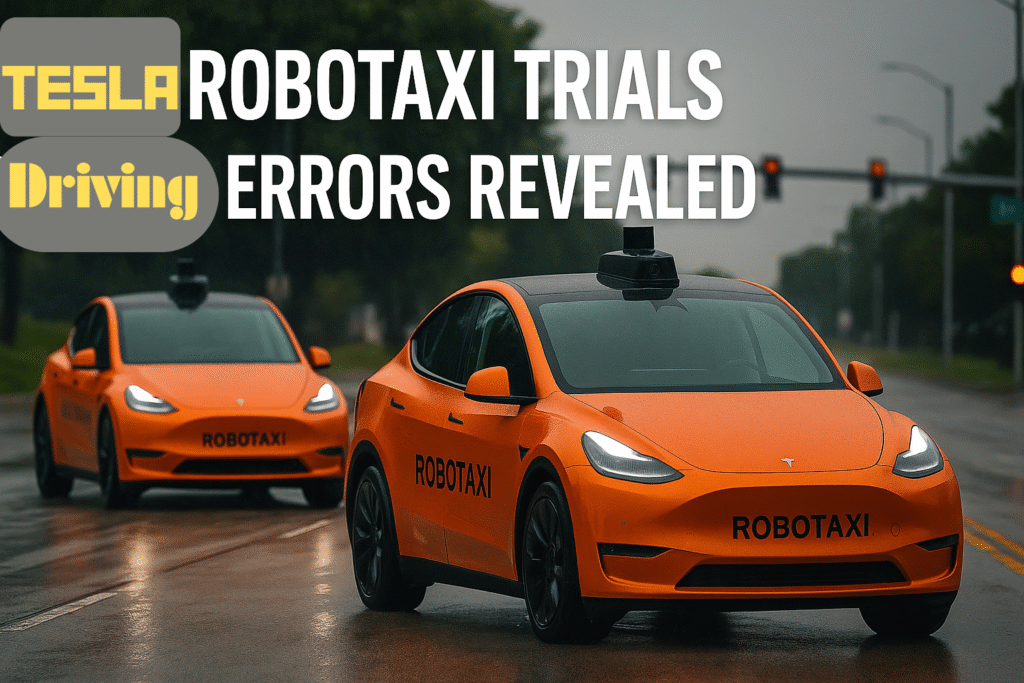
The Texas trials involve a limited number of modified Model Y vehicles, each operating inside a restricted urban zone. While the cars drive themselves, a human safety driver remains seated in case of emergencies — a standard requirement for autonomous testing in most U.S. states.
Passengers are invited through a mobile app, mimicking the experience of a ride-share service. Tesla’s ultimate goal is to make robotaxis available without human supervision, but these trials serve as the critical test phase before full deployment.
🚦 The Problems Observed on the Road
Though the program started smoothly, numerous on-road observations have raised eyebrows among experts and the public alike. Some of the main issues documented include:
- Lane drifting — robotaxis occasionally moved across dividing lines, entering the wrong lane before self-correcting.
- Harsh braking — cars stopped suddenly in traffic, even when no clear obstacle was visible.
- Incorrect signaling — indicators activated inconsistently with the vehicle’s intended turns.
- Awkward drop-offs — some passengers were let out near intersections or tight corners rather than safe curbsides.
None of these incidents caused crashes or injuries, but they revealed that Tesla’s system still struggles with urban unpredictability — pedestrians, cross-traffic, and complex intersections.
🏛️ Regulators and Safety Experts Respond
The National Highway Traffic Safety Administration (NHTSA) has requested more information about the trial, citing the need to ensure public safety during ongoing tests.
Transportation experts have voiced similar concerns, saying that while these results aren’t catastrophic, they show how hard it is to make autonomous cars truly human-like in judgment.
“Urban driving isn’t about speed or sensors — it’s about context,” noted one Texas-based researcher. “The cars must learn subtle behaviors humans take for granted, like predicting when another driver might hesitate or when a pedestrian will suddenly cross.”
🔋 Tesla’s Reaction
Tesla has maintained that the trials are performing within expectations for a beta-stage system. The company says that the majority of trips have been incident-free and that public attention tends to focus on isolated mistakes rather than the overall success rate.
Tesla’s engineers have reportedly begun updating their software to improve lane prediction, turn accuracy, and braking logic, using feedback and telemetry from Texas road data.
The automaker still plans to expand trials to other U.S. states in 2026, but that timeline may depend on regulatory confidence and public perception.
🧭 Why This Matters
These early glitches don’t necessarily spell failure. They represent the testing stage every major self-driving company must go through. Still, Tesla’s case is more high-profile — largely because its CEO, Elon Musk, has long claimed that true autonomy was “just around the corner.”
The public now expects the robotaxi to live up to that promise, not just in ideal lab conditions but in the chaos of real city traffic.
🧠 What Tesla Must Fix Before a Full Rollout
To gain both regulatory and consumer trust, Tesla will need to focus on five critical improvements:
- Consistent lane control – eliminating unplanned drifts or confusion in multi-lane environments.
- Context-aware braking – ensuring smoother deceleration and avoiding sudden halts.
- Dynamic drop-off logic – selecting safe passenger exit points automatically.
- Enhanced data transparency – publishing more safety reports from test drives.
- Adaptive learning – refining the AI with real-world edge-case data faster.
Only with visible progress in these areas can Tesla move closer to the dream of a fully driverless fleet.
🚗 The Bigger Picture: Can Robotaxis Really Replace Humans?
Tesla isn’t the only automaker chasing this goal. Rivals like Waymo, Cruise, and Zoox have also experienced setbacks — from technical malfunctions to public pushback.
But unlike them, Tesla is betting on a camera-only vision system rather than radar or lidar. This minimalist approach keeps costs down but increases dependence on near-perfect software interpretation — and that’s where even small errors become magnified.
🧩 Final Verdict: A Milestone, Not a Mistake
Tesla’s Texas trials mark a major step in the journey toward full autonomy. The mistakes, though embarrassing, are also necessary — every misstep feeds data that helps the AI improve.
Still, the company faces a delicate balance: move too fast, and public trust could erode; move too slow, and competitors might capture the market first.
Bottom line: The robotaxi dream is still alive — but Texas just showed the world how far it still has to drive.

Azeem Aosaf is a visionary entrepreneur, digital strategist, and educator with a mission to empower individuals through online earning and digital innovation. As the CEO of HelixNex LLC, he leads multiple ventures across e-commerce, education, and fintech—helping people turn their digital skills into sustainable income. Through his educational initiative RankTrak, Azeem has trained hundreds of students in SEO, YouTube Automation, Freelancing, and AI-powered marketing. His work bridges technology and opportunity—creating a platform where learning meets real-world success. When he’s not mentoring students or building digital products, Azeem shares insights on entrepreneurship, marketing trends, and financial freedom through his blogs and social platforms. His core belief: “Your Growth, Our Mission.”