A financial reality check for General Motors
General Motors has confirmed that it will record a $1.6 billion charge in the third quarter of 2025, citing the end of U.S. electric-vehicle tax incentives and a shift in federal climate policy.
The company said the charge reflects a strategic realignment of its EV business model as the market transitions away from government-backed incentives toward self-sustaining growth.
⚙️ Why GM Is Writing Down $1.6 B
GM’s one-time expense covers two main areas:
- Asset adjustments — revaluing EV-related plants, tools, and development assets after slowing or postponing capacity expansion.
- Contract costs — ending or renegotiating supply deals for batteries and components as production targets are revised.
Executives said the move allows GM to focus resources on the most profitable EV programs while adapting to new market dynamics.
“We’re ensuring our EV business is structured for long-term competitiveness, not short-term policy cycles,” said a GM spokesperson.
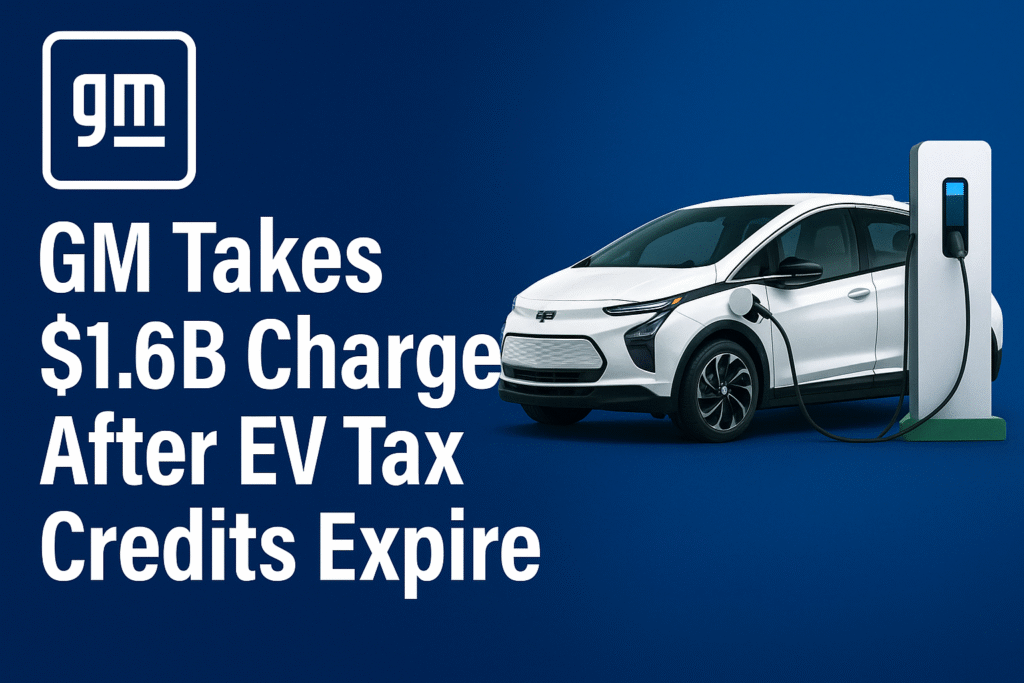
⚡ The End of the Tax Credit Era
For nearly a decade, U.S. buyers of new electric vehicles could claim up to $7,500 in federal tax credits, dramatically improving affordability.
That program officially expired on September 30, 2025, removing a key incentive that had boosted early EV demand.
Without those subsidies — and with relaxed emissions standards reducing regulatory pressure — many automakers are reassessing how quickly they can expand all-electric lineups while keeping margins healthy.
🚗 GM’s New Direction
The Detroit giant insists it is not abandoning electrification, but rather recalibrating.
Here’s what’s changing:
- Selective production: GM will prioritize high-margin EVs like the Cadillac Lyriq, GMC Hummer EV, and upcoming Chevrolet Blazer EV.
- Hybrid revival: A portion of resources will shift toward plug-in hybrids, which still meet stricter emission standards but attract broader buyers.
- Smarter investment: Battery plants and technology partnerships will be reviewed to ensure each project delivers strong returns.
This approach signals a shift from “volume growth” to “profitable growth.”
🧩 Ripple Effects Across the Industry
GM’s accounting charge mirrors broader tremors in the auto world:
- Ford and Stellantis have delayed select EV launches to control spending.
- Suppliers face shrinking orders as automakers slow new model rollouts.
- Investors are rewarding profitability over rapid expansion.
Analysts note that while overall EV adoption will keep rising, the pace of transition may slow until cost parity with gas vehicles improves.
📉 The Bigger Picture
This development marks a reality check for an industry that, for years, relied on government incentives to spark EV demand.
Now, carmakers must convince consumers on performance, reliability, and total ownership cost rather than subsidies.
“This is the start of a self-sustaining phase for EVs,” said auto analyst Sarah Lopez. “GM’s write-down isn’t retreat — it’s adaptation.”
✅ Bottom Line
GM’s $1.6 billion charge reflects more than an accounting decision — it’s the cost of evolving strategy in a changing policy landscape.
As tax breaks disappear, the automaker is repositioning itself for an environment where innovation and efficiency, not incentives, determine success.
The next chapter for GM’s electric vision will test whether the company can maintain momentum in a tougher, subsidy-free market.

Azeem Aosaf is a visionary entrepreneur, digital strategist, and educator with a mission to empower individuals through online earning and digital innovation. As the CEO of HelixNex LLC, he leads multiple ventures across e-commerce, education, and fintech—helping people turn their digital skills into sustainable income. Through his educational initiative RankTrak, Azeem has trained hundreds of students in SEO, YouTube Automation, Freelancing, and AI-powered marketing. His work bridges technology and opportunity—creating a platform where learning meets real-world success. When he’s not mentoring students or building digital products, Azeem shares insights on entrepreneurship, marketing trends, and financial freedom through his blogs and social platforms. His core belief: “Your Growth, Our Mission.”