A new wave in North American trade tensions
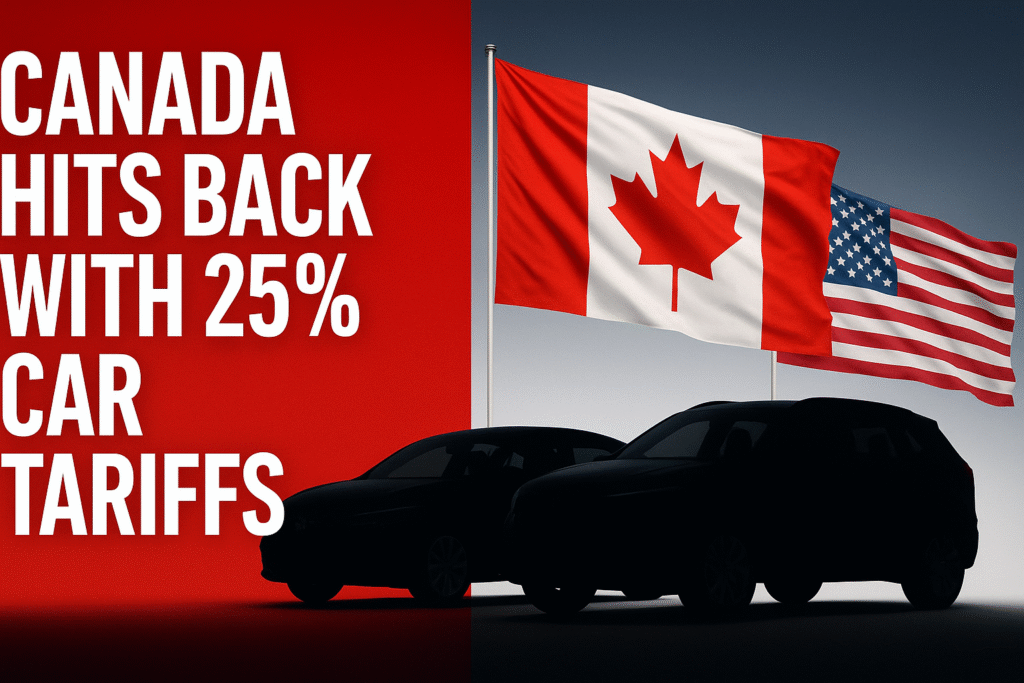
Canada has announced a bold move in its ongoing trade standoff with the United States — a 25% import tariff on American-built cars and light trucks.
The new duties, which took effect in early April 2025, mark one of Canada’s most aggressive trade countermeasures in recent years.
Ottawa says the step was necessary to defend domestic manufacturers and respond to Washington’s own tariff measures on Canadian goods. While the move is framed as temporary, analysts warn it could reshape the automotive market across North America.
Why Canada Is Raising Tariffs
The announcement followed weeks of tension after the U.S. government reintroduced tariffs on steel, aluminum, and select foreign-made vehicles — a move that included Canadian exports.
Prime Minister Mark Carney called the decision “unjustified and harmful,” saying Canada would “match the United States measure for measure.”
Under the new rule:
- A 25% tariff now applies to vehicles imported from the U.S. that don’t meet the content requirements set under the United States–Mexico–Canada Agreement (USMCA).
- Auto parts remain exempt, ensuring that supply chains for assembly plants in Ontario and Quebec remain functional.
- Vehicles built in U.S. factories that heavily rely on components from outside North America are most affected.
Also read this: Canada Drops 3% Digital Tax on U.S. Tech Giants — A Move to Ease Trade Tensions
⚙️ Impact on the Auto Industry
For U.S. Automakers
American manufacturers such as Ford, GM, and Stellantis — all of which export thousands of units to Canada — will see immediate cost increases. Automakers are already calculating how to adjust pricing or production to maintain competitiveness.
Industry analysts estimate that vehicles assembled in the U.S. but sold in Canada could become $3,000–$5,000 more expensive once tariffs are factored in.
For Canadian Consumers
Canadians can expect higher car prices for imported U.S. models. Dealers are warning that some American-built SUVs and pickup trucks could face limited availability or delayed shipments.
This could shift demand toward Canada-assembled or Mexico-produced vehicles that are unaffected by the new tariffs.
For Canada’s Economy
The government is betting that the tariffs will pressure U.S. leaders to return to negotiations — but there’s risk involved.
If the U.S. responds with additional trade barriers, it could affect other Canadian exports, from energy products to agriculture.
🔍 A Broader Trade Chess Game
This tariff escalation isn’t just about cars — it’s part of a broader North American trade tug-of-war.
The United States claims Canada’s subsidies and tax policies have distorted the automotive market.
Meanwhile, Canada argues that the U.S. violated the spirit of the USMCA, which was meant to promote fair trade and open borders among the three member nations.
“We will always defend our workers and industries,” Carney said in a press conference.
“Canada will never accept one-sided economic policies from our closest partner.”
Behind the scenes, both sides are still talking. Sources inside the trade ministry say Canada is open to removing tariffs once the U.S. reverses its duties on Canadian-made vehicles and raw materials.
🚗 How Automakers Are Reacting
Major automakers have urged both governments to find a quick resolution. They warn that prolonged tariffs could disrupt production schedules and consumer confidence.
Industry groups like the Canadian Vehicle Manufacturers’ Association (CVMA) have cautioned that both economies depend heavily on cross-border manufacturing. A single modern car often crosses the border six to eight times before completion.
To mitigate the blow, some automakers are considering relocating certain assembly operations to Canada or Mexico, ensuring compliance with regional trade rules and tariff exemptions.
📉 Potential Long-Term Consequences
- Higher vehicle costs may slow demand in Canada’s already cooling car market.
- Supply chain adjustments could strengthen local production but raise operational costs.
- Trade negotiations could shape a new version of the USMCA — one more favorable to localized manufacturing.
Experts say the next few months will determine whether this standoff becomes a long-term trade conflict or a short-term power play.
✅ The Takeaway
Canada’s new 25% tariff on U.S. vehicle imports is as much a political signal as it is an economic weapon.
It underscores how fragile trade relations can become — even among allies — when domestic industries feel the pinch of foreign policy decisions.
For now, drivers and automakers alike are stuck waiting to see which side blinks first.
Bottom line: The road ahead for North American trade just got bumpier.

Azeem Aosaf is a visionary entrepreneur, digital strategist, and educator with a mission to empower individuals through online earning and digital innovation. As the CEO of HelixNex LLC, he leads multiple ventures across e-commerce, education, and fintech—helping people turn their digital skills into sustainable income. Through his educational initiative RankTrak, Azeem has trained hundreds of students in SEO, YouTube Automation, Freelancing, and AI-powered marketing. His work bridges technology and opportunity—creating a platform where learning meets real-world success. When he’s not mentoring students or building digital products, Azeem shares insights on entrepreneurship, marketing trends, and financial freedom through his blogs and social platforms. His core belief: “Your Growth, Our Mission.”