A New Era for Air Mobility
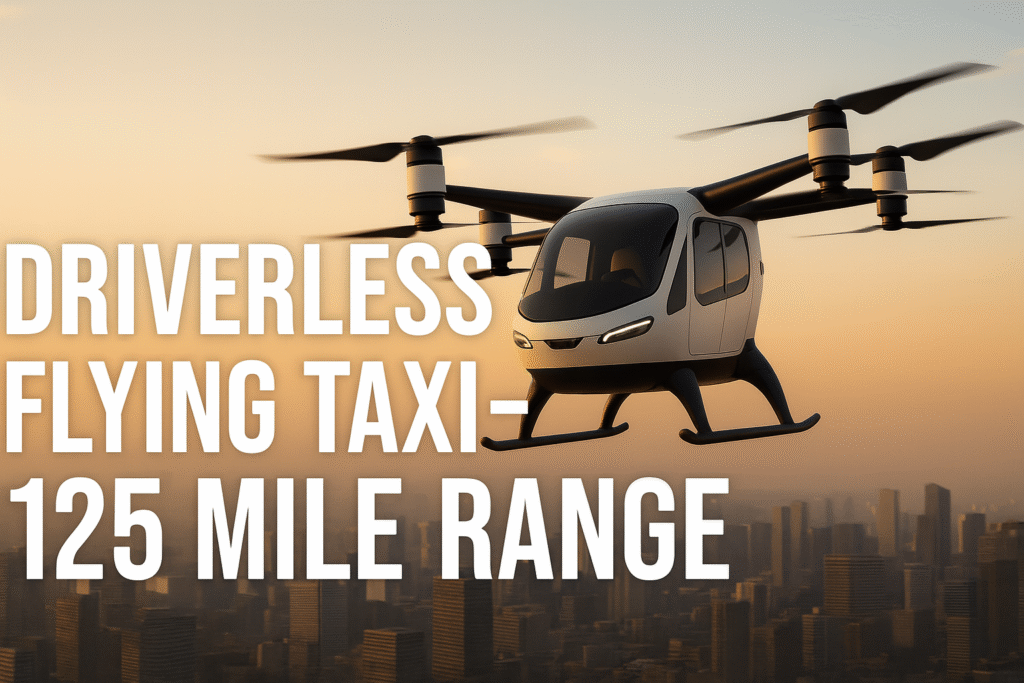
China’s advanced-air-mobility company EHang has officially launched its next-generation electric vertical take-off and landing aircraft, the VT35, a sleek, fully autonomous flying taxi capable of covering up to 125 miles (200 km) on a single charge.
This launch marks a major milestone in the shift from experimental drones to practical, long-range, passenger-carrying aircraft.
The VT35, designed for intercity travel, bridges the gap between short-hop urban air taxis and conventional aircraft. With zero onboard pilots, electric propulsion, and advanced AI-based flight control, EHang is positioning it as a sustainable and scalable solution for next-decade transportation.
✈️ Design and Performance Highlights
The VT35’s engineering blends aerodynamic efficiency with simplicity. Its structure includes:
- Dual wings with eight vertical-lift propellers and one rear pusher propeller.
- A two-seat cockpit optimized for passenger comfort and panoramic views.
- Maximum take-off weight: roughly 950 kg (2,090 lb).
- Cruising speed: about 130–135 mph (≈ 216 km/h).
- Range: ~200 km per charge, extending well beyond typical city-only eVTOL limits.
Unlike early electric air taxis built for short distances of 20–40 miles, the VT35’s wings allow energy-efficient forward flight, significantly boosting range and speed while keeping operating costs low.
🌍 The Significance of a 125-Mile Range
🏙️ Expanding Beyond City Limits
Traditional eVTOLs focus on urban commuting. The VT35 changes that narrative — it’s built for regional mobility, connecting nearby cities separated by water, mountains, or highways clogged with traffic.
Flights such as Shenzhen to Macau or Shanghai to Hangzhou could soon take less than 40 minutes, all with zero emissions.
🤖 Completely Autonomous Operation
One of the biggest breakthroughs is autonomy. The VT35 does not require a pilot.
EHang’s AI flight-control system handles take-off, navigation, and landing, monitored remotely by certified ground operators. The goal is to make aerial transport as routine as summoning a ride-share car — simply request, board, and go.
🔋 Powertrain and Battery Innovation
EHang has improved battery-density and redundancy systems, allowing safe energy management across multiple rotors. The company also designed fast-swap battery modules to minimize downtime between flights.
🧭 Certification and Deployment Plans
The Civil Aviation Administration of China (CAAC) has accepted EHang’s application for type certification of the VT35.
If approved, it will join the company’s smaller EH216-S, which recently became the world’s first certified passenger-carrying eVTOL.
EHang plans to:
- Begin commercial pilot routes in 2026 for tourism, emergency logistics, and airport shuttles.
- Set up production facilities in Hefei, China, to scale manufacturing.
- Partner with local governments to integrate the VT35 into “low-altitude economic zones,” a growing initiative to regulate and expand aerial mobility networks.
🛫 Target Markets and Use-Cases
- Tourism & Sightseeing – Scenic coastal or mountain routes with aerial views.
- Regional Transit – Short business trips replacing congested highways.
- Emergency Services – Disaster response and medical evacuation missions where speed matters.
- Cargo Delivery – Transport of light, time-sensitive goods to remote or island areas.
With a unit price of roughly US $900,000, the VT35 is initially aimed at fleet operators and municipal programs rather than individual buyers.
Also read this Ford Recalls 625,000 Vehicles in the U.S. Over Seat-Belt and Camera Safety Issues
⚠️ Challenges Ahead
Despite its promise, several obstacles remain:
- Global regulations: Few countries have frameworks for autonomous passenger flight.
- Infrastructure gaps: Vertiports, charging systems, and flight corridors must be built.
- Battery performance: Weather, load, and altitude still affect range and safety margins.
- Public acceptance: Passengers must learn to trust fully pilotless aircraft.
However, the groundwork is being laid — and China’s aggressive push toward urban-air mobility may accelerate adoption worldwide.
🔮 The Bigger Picture
The VT35 isn’t just a futuristic concept; it’s a working prototype of how sustainable aerial transportation might soon look.
Its design efficiency and autonomous control could help cut commuting times, reduce pollution, and redefine the way people and goods move across regions.
For EHang, it’s also a statement of intent — that the company aims to lead the global eVTOL race, much like Tesla did for EVs a decade ago.
“The VT35 proves that electric flight isn’t science fiction anymore — it’s scalable technology on the edge of real-world service,” said an EHang spokesperson during the launch event.
If certifications and public trials succeed, passengers could board their first driverless regional air taxi as soon as 2026.

Azeem Aosaf is a visionary entrepreneur, digital strategist, and educator with a mission to empower individuals through online earning and digital innovation. As the CEO of HelixNex LLC, he leads multiple ventures across e-commerce, education, and fintech—helping people turn their digital skills into sustainable income. Through his educational initiative RankTrak, Azeem has trained hundreds of students in SEO, YouTube Automation, Freelancing, and AI-powered marketing. His work bridges technology and opportunity—creating a platform where learning meets real-world success. When he’s not mentoring students or building digital products, Azeem shares insights on entrepreneurship, marketing trends, and financial freedom through his blogs and social platforms. His core belief: “Your Growth, Our Mission.”