📉 Weaker Demand Prompts a Shift
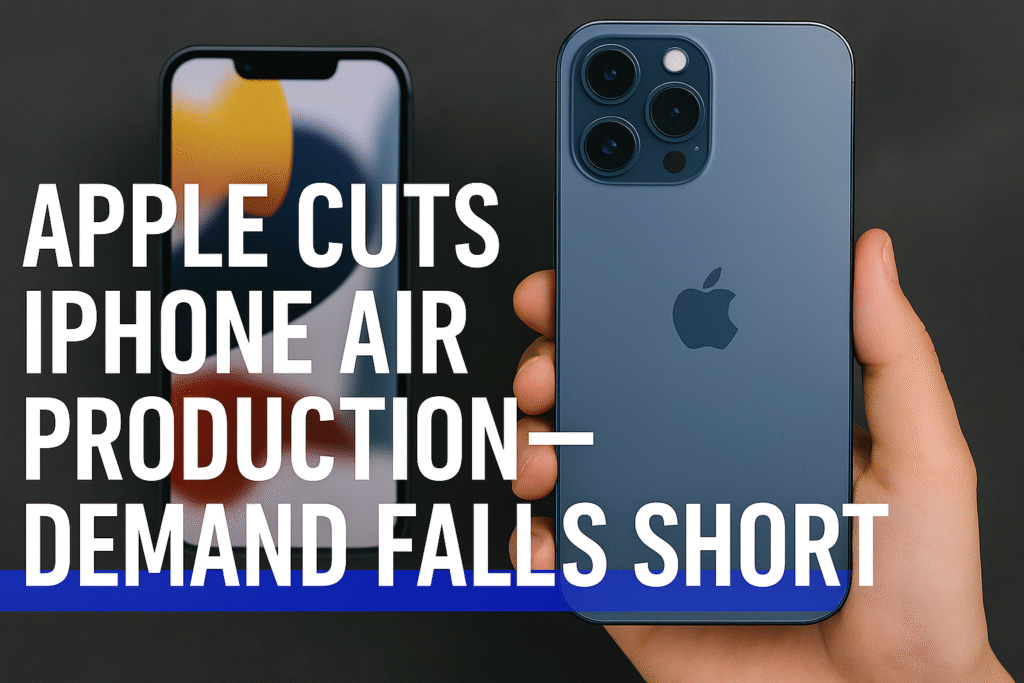
Apple appears to be scaling back production of its recently launched iPhone Air, following slower-than-expected global sales.
Industry insiders suggest that the lightweight model, designed as a mid-tier option in the iPhone 17 lineup, failed to capture the level of demand Apple anticipated — leading to a production cut estimated at roughly one million units.
While initial hype around the “Air” branding drew curiosity, sales data from multiple markets show a stronger consumer preference for the standard iPhone 17 and the premium Pro and Pro Max models.
⚙️ Why Apple Is Making This Move
The decision to reduce iPhone Air output isn’t sudden — it’s a strategic response to market signals and consumer behavior.
1. Buyer Priorities Have Shifted
Customers increasingly value camera performance, battery life, and processing power over design thinness or lightweight form factors. The iPhone Air’s slimmer frame reportedly comes with compromises in those areas, steering buyers toward other models.
2. Global Demand Imbalance
In regions like China, early interest in the iPhone Air was solid, but markets such as Europe and North America saw tepid response. This uneven demand likely contributed to Apple’s reallocation of manufacturing resources.
3. Optimizing the Product Mix
Apple is known for its precise inventory control. Reducing iPhone Air production allows the company to redirect resources toward high-demand models that deliver better profit margins — such as the iPhone 17 Pro lineup.
📱 What This Means for Consumers
🔸 Possible Price Drops Ahead
With Apple trimming output, unsold iPhone Air units could see price reductions or limited-time trade-in promotions as retailers clear inventory.
🔸 Improved Availability of Other Models
Buyers interested in the standard iPhone 17 or the Pro versions may find faster delivery times, as Apple reallocates production capacity to meet stronger demand for those models.
🔸 Hints About Apple’s Future Strategy
This move may signal that Apple is pivoting away from its “ultra-thin” approach and leaning more toward performance-first designs — especially with its upcoming iPhone 18 series and rumored foldable projects.
Also Read this Apple Delays Vision Pro 2 — Strategy Reset or Warning Sign for Spatial Computing?
🧠 What Analysts Are Saying
Market analysts see this as a realignment, not a retreat. The iPhone Air was an experiment — Apple’s attempt to capture a segment between the entry-level and flagship tiers. However, the brand’s customers seem more willing to pay extra for premium features than settle for a lighter, lower-cost alternative.
Some experts believe the Air nameplate may evolve rather than vanish. It could return later as part of a new product family, potentially bridging smartphones and Apple’s growing wearables or foldable devices portfolio.
✅ The Bigger Picture
Apple’s quick reaction underlines its operational agility. By trimming underperforming products early, the company preserves both profitability and supply chain efficiency heading into the holiday season.
Ultimately, this decision underscores a simple truth: in 2025’s competitive smartphone market, consumers crave value and innovation, not just sleek design.
“Apple isn’t stepping back—it’s recalibrating for what customers really want,” says one industry observer.
🔍 Frequently Asked Questions (FAQ)
1. Why is Apple reducing iPhone Air production?
Apple is cutting iPhone Air production because demand has been lower than expected. Consumers are showing stronger interest in the standard iPhone 17 and the Pro/Pro Max models, which offer more features and better performance for the price.
2. How many iPhone Air units were affected by the production cut?
Industry estimates suggest that Apple has reduced iPhone Air production by about one million units. The company is redirecting resources toward higher-selling iPhone 17 models to maximize efficiency and profitability.
3. Will Apple discontinue the iPhone Air completely?
Apple hasn’t officially announced discontinuation of the iPhone Air. However, given its limited popularity, future versions may be rebranded, redesigned, or merged into other product lines. The company is known for phasing out weaker performers while testing new product categories.
4. Will the production cut affect iPhone Air pricing?
Possibly. With fewer units being produced and some inventory still available, price adjustments or promotional offers could appear in select regions. Retailers may discount remaining stock to boost sales.
5. What does this mean for Apple’s future smartphone strategy?
This move signals that Apple is refocusing on its core strengths — performance, camera quality, and ecosystem integration. The company is prioritizing its flagship devices and exploring innovations like foldables and AI-powered features rather than expanding its mid-tier lineup.

Azeem Aosaf is a visionary entrepreneur, digital strategist, and educator with a mission to empower individuals through online earning and digital innovation. As the CEO of HelixNex LLC, he leads multiple ventures across e-commerce, education, and fintech—helping people turn their digital skills into sustainable income. Through his educational initiative RankTrak, Azeem has trained hundreds of students in SEO, YouTube Automation, Freelancing, and AI-powered marketing. His work bridges technology and opportunity—creating a platform where learning meets real-world success. When he’s not mentoring students or building digital products, Azeem shares insights on entrepreneurship, marketing trends, and financial freedom through his blogs and social platforms. His core belief: “Your Growth, Our Mission.”