🍏 Apple’s Lightest iPhone Faces Heavy Challenges
Apple’s sleek new iPhone Air, launched to global fanfare earlier this year, is facing its first major setback.
Industry insiders say Apple has reduced production targets for the lightweight flagship model following lower-than-expected demand and manufacturing challenges.
According to reports from Asian supply chains, Apple has asked major partners like Foxconn and Luxshare Precision to scale back production by roughly 25–30% for the rest of 2025.
This shift comes just months after the iPhone Air’s release — a rare move for Apple, which typically maintains high production levels through the holiday quarter.
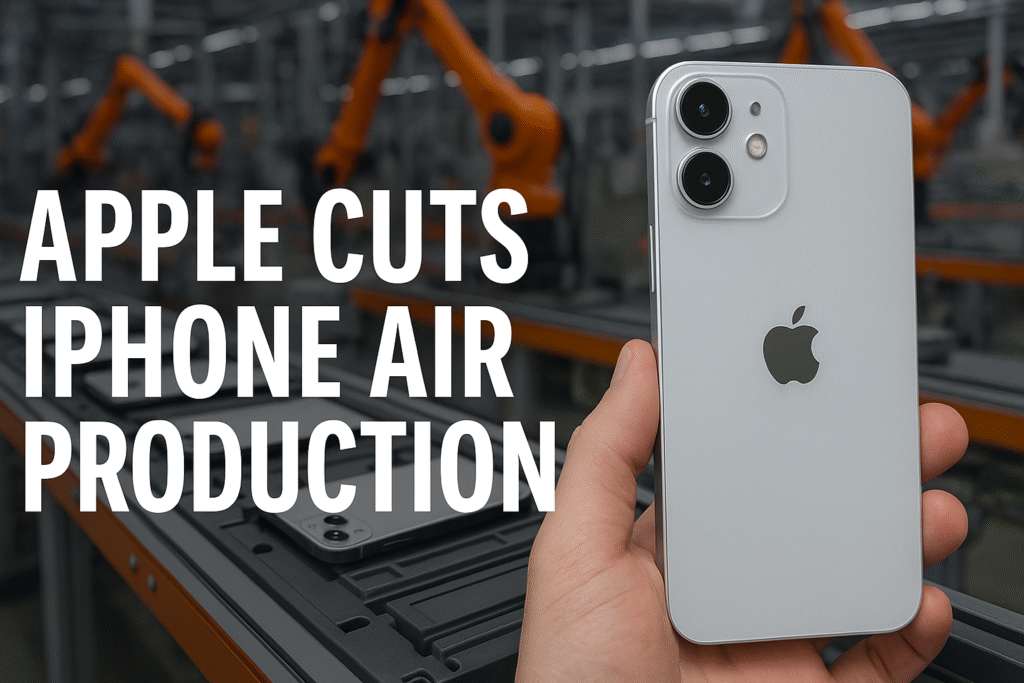
📱 iPhone Air: Apple’s “Slim Revolution”
The iPhone Air, introduced alongside the iPhone 17 series in September, was pitched as Apple’s thinnest and most elegant smartphone yet.
🔹 Key Highlights:
- 6.3-inch OLED edge-to-edge display
- Ultra-thin titanium-aluminum frame
- A19 Bionic chip for improved efficiency
- MagSafe 2.0 and 45W wireless charging
- iOS 19 with new AI-based photo and text tools
Apple marketed the device as the perfect balance between performance and portability, sitting between the standard iPhone 17 and the Pro models in price.
But despite early hype, industry data now shows momentum slowing faster than Apple expected.
Read Also This: 🚀 Samsung’s “Project Moohan” XR Headset: What to Expect from the October Launch
🏭 What’s Behind the Production Cuts?
Several factors appear to be influencing Apple’s decision to reduce output of the iPhone Air.
1. Slower Global Sales
Initial sales in the U.S. were strong, but in regions like Europe and China, interest waned after launch.
Analysts believe that many buyers opted for cheaper iPhone models or the higher-end Pro line, leaving the Air stuck in the middle.
2. Economic Uncertainty
With inflation still biting in key markets, consumers are being more cautious. Many are delaying upgrades or choosing older models that now cost significantly less.
3. Component and Yield Issues
Manufacturing partners have reportedly struggled to maintain consistent output of the Air’s ultra-thin OLED panels, contributing to supply inefficiencies and production slowdowns.
4. Strategic Reallocation
Sources say Apple is redirecting production capacity toward its Pro and MacBook Air M4 lines, both of which are performing better globally.
💬 Analysts Weigh In
Market analysts say the production cut doesn’t necessarily signal failure — but rather a strategic correction.
“Apple is simply responding to changing demand,” explains Mark Edwards, senior tech analyst at FutureView Insights.
“When a product doesn’t meet early projections, Apple adjusts quickly to protect margins.”
Still, others believe the decision hints at deeper issues with Apple’s mid-range positioning, which has grown more crowded as competitors launch aggressively priced premium smartphones.
“The iPhone Air’s pricing overlaps with the iPhone 17 Pro and confuses buyers,” said Priya Joshi, mobile market researcher at TechRadar Global. “Consumers either go cheaper or go all in for the Pro — few choose the middle ground anymore.”
⚙️ Impact on Apple’s Supply Chain
Apple’s manufacturing ecosystem is vast, and even small changes ripple across multiple partners.
Suppliers in Shenzhen, Zhengzhou, and Chennai are reportedly adjusting staffing and production schedules to accommodate the iPhone Air cutback.
Meanwhile, chipmaker TSMC continues producing the A19 Bionic chip at full scale, suggesting Apple could still ramp up iPhone Air output later if demand rebounds in early 2026.
For now, Apple appears focused on stabilizing production of higher-margin models like the iPhone 17 Pro Max and MacBook Air M4, both strong sellers this quarter.
🌍 The Global Smartphone Context
The global smartphone industry is in flux.
Recent data from IDC shows worldwide shipments fell around 5% in 2025, with consumers keeping devices longer and gravitating toward AI-powered flagships or budget-friendly options.
Apple has maintained strong performance overall, but mid-range devices — like the iPhone Air — face stiffer competition from brands such as Samsung, Honor, and OnePlus, which now offer similar performance at lower prices.
This trend could explain why Apple is focusing on its premium and AI-integrated lineup, where profit margins remain higher.
💡 What Happens Next
The production adjustment doesn’t mean the end for the iPhone Air — rather, it signals Apple’s pragmatic approach to changing market realities.
Some insiders believe Apple could refresh the iPhone Air in mid-2026, potentially with:
- A lower price point, or
- New AI and camera features to better differentiate it from the standard iPhone lineup.
Retailers in the UK and Europe have already started offering minor discounts on current iPhone Air models — an early sign Apple may be clearing inventory ahead of future adjustments.
📈 The Takeaway
- Production cut: Approximately 25–30% for Q4 2025
- Main causes: Soft demand, component issues, and strategy shift
- Focus shift: Toward iPhone Pro and MacBook Air models
- Outlook: Apple remains flexible, ready to adjust production as trends evolve
“Apple’s greatest strength is agility,” says analyst Tom Jenkins from Mobile Insight UK.
“This isn’t a setback — it’s simply Apple protecting its ecosystem and margins in a turbulent global market.”
❓ Frequently Asked Questions (FAQ)
1. Why is Apple cutting iPhone Air production?
Due to lower-than-expected global demand and supply chain efficiency adjustments.
2. How big is the production reduction?
Roughly 25–30% fewer units are expected to be produced through late 2025.
3. Will Apple discontinue the iPhone Air?
No. The production cut is temporary — Apple may relaunch or refresh the model next year.
4. Is this linked to poor performance?
Not directly. Apple regularly adjusts production to balance inventory and sales forecasts.
5. Will prices drop?
Retailers in some markets have begun offering discounts, but Apple hasn’t changed its official pricing.

Azeem Aosaf is a visionary entrepreneur, digital strategist, and educator with a mission to empower individuals through online earning and digital innovation. As the CEO of HelixNex LLC, he leads multiple ventures across e-commerce, education, and fintech—helping people turn their digital skills into sustainable income. Through his educational initiative RankTrak, Azeem has trained hundreds of students in SEO, YouTube Automation, Freelancing, and AI-powered marketing. His work bridges technology and opportunity—creating a platform where learning meets real-world success. When he’s not mentoring students or building digital products, Azeem shares insights on entrepreneurship, marketing trends, and financial freedom through his blogs and social platforms. His core belief: “Your Growth, Our Mission.”