Historic Low for UK Car Manufacturing
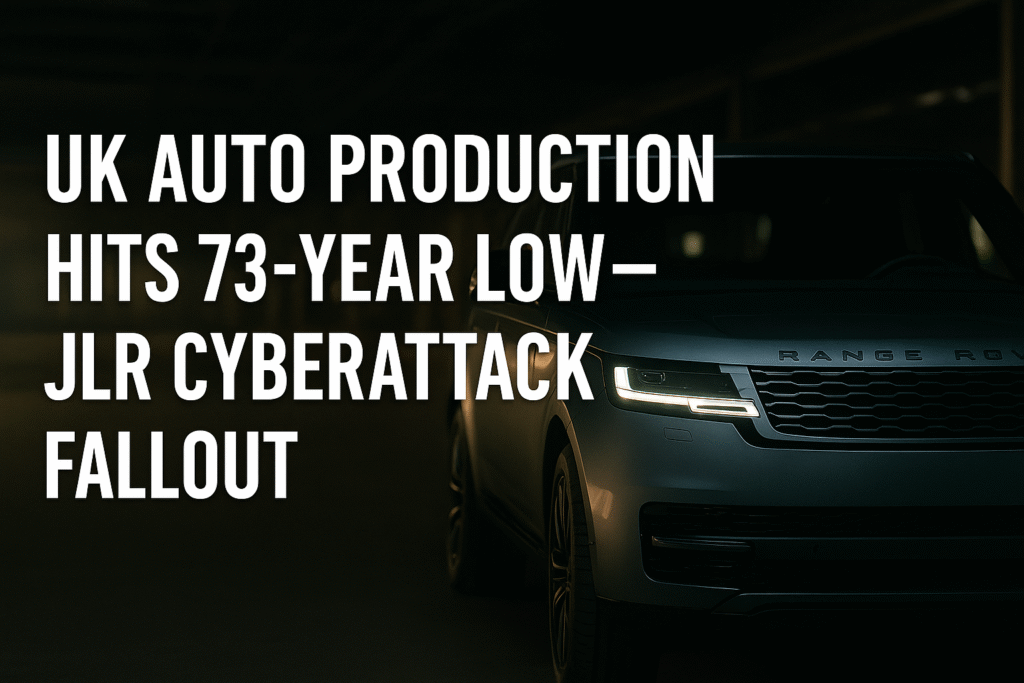
The United Kingdom’s automotive industry has hit its lowest monthly output since the early 1950s, with total car production dropping 27% year-over-year in September 2025. Industry analysts attribute this sharp decline primarily to Jaguar Land Rover’s (JLR) extended shutdown following a cyberattack that crippled its manufacturing network.
According to industry data, only around 51,000 vehicles rolled off production lines across the UK during September — the lowest output since 1952, marking one of the most challenging months in modern automotive history.
🧠 The Cyberattack That Stopped Production
Jaguar Land Rover, the UK’s largest car manufacturer, was forced to halt operations across key facilities — including Solihull, Halewood, and Wolverhampton — after a late-August cyberattack compromised core IT systems.
The company’s internal logistics, parts ordering, and production tracking systems were disabled, effectively pausing manufacturing for several weeks.
As a result, JLR’s output dropped by more than 60,000 vehicles during the quarter, significantly impacting both domestic sales and exports.
A JLR spokesperson called the event “the most serious production disruption in the company’s history,” adding that the firm is “focused on recovery and future resilience.”
📉 Economic Fallout Across the UK Auto Industry
The cyberattack didn’t just affect JLR — it rippled throughout the UK’s broader manufacturing supply chain.
Suppliers that rely on JLR’s volume suffered severe financial strain as parts orders were cancelled or delayed. Analysts estimate that the shutdown has cost the UK economy nearly £2 billion in lost output, wages, and supplier payments.
Export figures also declined by over 25%, with some shipments delayed indefinitely while manufacturers recalibrated their logistics systems.
⚙️ How Jaguar Land Rover Is Recovering
After five weeks of downtime, JLR began a phased restart of its production lines, prioritizing high-demand and high-profit vehicles such as the Range Rover, Defender, and Discovery.
The company has implemented new cybersecurity protocols, expanded its data recovery systems, and launched a comprehensive supply chain support program to assist smaller partners affected by the outage.
While operations have resumed, JLR doesn’t expect full production recovery until early 2026. The automaker has also confirmed additional investment in digital infrastructure to prevent similar incidents in the future.
Also Read this UK Vehicle Output Fell by 12% in H1 2025 — But EV Exports Keep Britain’s Auto Industry Hopeful
💬 Industry Experts Weigh In
Automotive analysts describe the event as a wake-up call for manufacturers worldwide.
“Modern car production relies as much on data as it does on machinery,” said one industry expert. “A single digital breach can stop an entire supply chain in its tracks.”
Experts believe the incident will accelerate investment in cybersecurity, supply chain diversification, and factory automation, not only at JLR but across Europe’s manufacturing sector.
🚗 Impact on Consumers and Dealers
For customers, the disruption means longer waiting times for new vehicles — especially for premium JLR models.
Dealerships across the UK and Europe have already reported delays in deliveries, with certain configurations being postponed until next year.
Some dealers have begun offering extended warranties and incentives to retain customers during the supply gap, while others expect price adjustments once production stabilizes.
✅ What Comes Next for JLR
Despite the setback, Jaguar Land Rover remains confident in its long-term growth strategy, focusing on the electrification of its lineup under the Reimagine plan.
The company aims to recover lost ground through new model launches and greater production efficiency in 2026.
JLR’s experience is likely to shape how automakers worldwide balance digital innovation with security, proving that in the connected car era, cyber protection is as vital as engineering precision.
Frequently Asked Questions (FAQ)
1. Why did UK car production drop to a 73-year low?
The steep decline in UK car production during September 2025 was mainly due to Jaguar Land Rover’s extended factory shutdown following a major cyberattack. The incident disrupted the company’s IT systems, halting manufacturing and logistics operations across its main plants for several weeks.
2. How badly was Jaguar Land Rover affected by the cyberattack?
Jaguar Land Rover, the UK’s largest carmaker, saw a significant production loss — over 60,000 vehicles were delayed or cancelled. The company’s Solihull, Halewood, and Wolverhampton plants were all impacted, with full recovery not expected until early 2026.
3. How did the cyberattack impact the wider UK economy?
The production halt at JLR rippled across the automotive supply chain, affecting hundreds of smaller suppliers. Economists estimate the economic damage at nearly £2 billion, including lost exports, reduced manufacturing output, and temporary layoffs in related industries.
4. What steps is Jaguar Land Rover taking to recover?
JLR has initiated a phased restart of its operations, focusing first on high-demand models like the Range Rover and Defender. The company is also:
- Strengthening its cybersecurity infrastructure
- Investing in digital backup systems
- Launching a support program for affected suppliers
These efforts are aimed at restoring stability and preventing future disruptions.
5. How does this event affect car buyers?
Customers can expect longer waiting times for new JLR vehicles, especially for custom or high-end models. Dealers have already reported delays extending into early 2026, and prices may rise slightly due to reduced supply and increased production costs.
6. Could this happen again to other automakers?
Yes. The incident highlights the growing risk of cyberattacks in the automotive sector, where modern manufacturing heavily depends on connected digital systems. Experts warn that similar threats could disrupt other automakers if cybersecurity measures aren’t strengthened across the industry.
7. What lessons does this hold for the UK automotive industry?
The event underscores the need for resilient digital systems, diversified production strategies, and greater investment in cybersecurity. It also demonstrates how dependent the UK’s manufacturing base remains on a few large automakers like JLR.

Azeem Aosaf is a visionary entrepreneur, digital strategist, and educator with a mission to empower individuals through online earning and digital innovation. As the CEO of HelixNex LLC, he leads multiple ventures across e-commerce, education, and fintech—helping people turn their digital skills into sustainable income. Through his educational initiative RankTrak, Azeem has trained hundreds of students in SEO, YouTube Automation, Freelancing, and AI-powered marketing. His work bridges technology and opportunity—creating a platform where learning meets real-world success. When he’s not mentoring students or building digital products, Azeem shares insights on entrepreneurship, marketing trends, and financial freedom through his blogs and social platforms. His core belief: “Your Growth, Our Mission.”