Car buyers across the globe are entering a new era of decision-making. A recent global automotive consumer study (2025) highlights a shift in priorities — from status and performance toward value, reliability, technology, and sustainability.
The once-predictable car market is transforming rapidly as affordability concerns, digital connectivity, and environmental awareness reshape how consumers choose their next vehicle.
This article breaks down the latest findings and explains how automakers in the UK, US, and Canada can navigate this changing landscape.
📊 1. Affordability & Reliability Now Trump Luxury
For years, consumers were drawn to bold designs, horsepower, and prestige. In 2025, however, cost of ownership and long-term reliability top the list.
Rising inflation, higher interest rates, and record new-car prices have turned car shopping into a financial balancing act. Many buyers now prioritize:
- Low maintenance and fuel costs
- Extended warranty coverage
- Strong resale value
- Transparent financing and lease terms
In the UK and Canada especially, economic uncertainty has pushed buyers to think pragmatically — seeking dependable, fuel-efficient vehicles rather than flashy upgrades.
Read Also This: 🚗 Europe–US Vehicle Trade Remains Strong Despite Friction
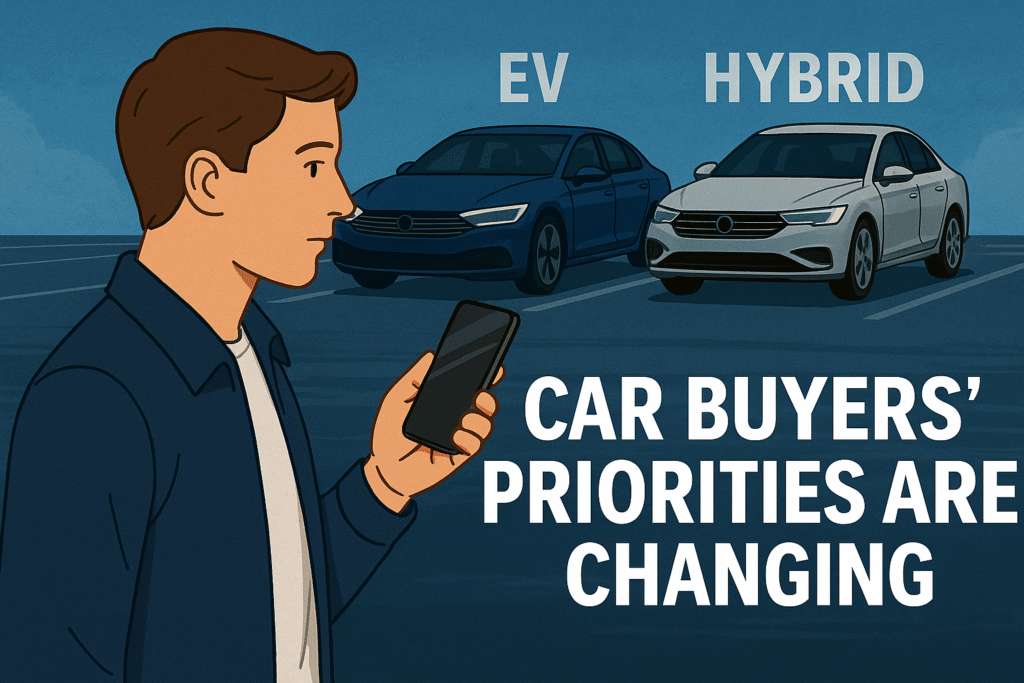
⚡ 2. Electric Vehicle Enthusiasm Slows — Hybrid Appeal Grows
While the electric vehicle (EV) movement continues, full adoption is proving slower than expected. The latest data suggests that many consumers are hesitant to switch fully to battery-electric vehicles (BEVs) due to:
- High upfront costs
- Limited charging networks
- Range anxiety on long trips
- Unclear battery longevity and resale values
Instead, hybrids and plug-in hybrids (PHEVs) are gaining ground as practical middle-ground choices. They offer better fuel efficiency and lower emissions without the anxiety of full electrification.
In the United States, hybrid SUVs and trucks are leading sales growth, while in the UK, buyers are delaying BEV purchases until charging infrastructure improves.
📱 3. Connectivity and Smart Features Are Must-Haves
Today’s car buyers expect smart, connected experiences — from infotainment to personalized driving profiles. Cars are evolving into digital devices on wheels, and consumers are paying attention to:
- Over-the-air software updates
- Smartphone integration (Apple CarPlay, Android Auto)
- Voice assistants and AI copilots
- Real-time diagnostics and navigation
- In-car Wi-Fi and subscription-based add-ons
However, while buyers love convenience, they are increasingly cautious about data privacy and subscription fatigue. Many reject the idea of paying monthly fees for basic features like heated seats or adaptive cruise control.
The takeaway for automakers: connectivity should enhance value, not exploit it.
🔁 4. Brand Loyalty Is Declining Fast
In a more transparent, comparison-driven marketplace, brand loyalty is fading. Consumers now switch brands freely, driven by better deals, design appeal, or digital experience.
A decade ago, brand identity meant everything. Today, the deciding factor is value perception — a blend of price, features, and long-term trust.
Younger buyers, especially millennials and Gen Z, are far less likely to “stick” with a single carmaker. Instead, they prioritize:
- Latest technology
- Personalized offers
- Eco-friendly credentials
- Fast, digital-first buying experiences
This shift challenges legacy automakers to rethink how they build relationships beyond the showroom.
🛞 5. Ownership Models Are Evolving
Traditional car ownership — buying and keeping a vehicle for years — is losing ground. Consumers, particularly urban professionals, are embracing flexible mobility options such as:
- Short-term leasing and car subscriptions
- Pay-per-use driving services
- Car-sharing and mobility-as-a-service (MaaS) platforms
These models offer freedom without long-term financial commitments.
In markets like London and Toronto, younger drivers view cars less as possessions and more as on-demand mobility tools. This shift is forcing automakers and dealerships to explore service-based revenue streams alongside traditional sales.
💡 6. Regional Differences Are Striking
While the global trends are clear, the motivations vary regionally:
🇬🇧 United Kingdom:
- Focus on value, fuel economy, and hybrid technology.
- Consumers wary of full EV adoption until infrastructure matures.
- Strong interest in extended warranties and after-sales reliability.
🇺🇸 United States:
- Larger vehicles still dominate, but hybrid pickups and SUVs are surging.
- Interest in digital convenience features and connected ecosystems.
- Many buyers view EVs as secondary vehicles rather than primary ones.
🇨🇦 Canada:
- Growing eco-awareness but budget-conscious decision-making.
- Consumers appreciate government incentives for green vehicles but demand greater affordability.
- High trust in local dealerships and service transparency.
These differences show that while technology unites global markets, economic realities and infrastructure readiness still shape regional preferences.
🧭 How Automakers Can Respond
🔹 Reimagine the Product Mix
Offer a balanced lineup that includes hybrids, efficient gas models, and accessible EVs — not just luxury electrics.
🔹 Prioritize Digital Transparency
Simplify online car shopping with clear pricing, virtual showrooms, and real-time financing calculators.
🔹 Focus on Lifetime Value
After-sales care, warranty plans, and software updates can foster customer trust — the new form of brand loyalty.
🔹 Integrate Tech Responsibly
Embrace AI and connectivity but avoid overcharging for basic features. Transparency builds goodwill.
🔹 Embrace Mobility Services
Develop or partner with subscription-based and shared mobility platforms to engage younger, urban consumers.
🔮 What’s Next for Car Buyers in 2026
The next wave of automotive evolution will center on digital-first ownership and experience-driven design. Expect:
- Vehicles that improve over time via software
- Personalized driving ecosystems connected to smartphones and homes
- Subscription models blending car ownership and convenience
- Data-driven personalization with stronger privacy controls
Automakers that listen — not just sell — will define the industry’s future.
💬 Final Thoughts
The modern car buyer is smarter, more connected, and more cautious than ever before. They value flexibility, reliability, and fair pricing above all else — while demanding technology that truly enhances their driving experience.
For automakers, the challenge is clear: adapt to the new consumer mindset or risk being left behind.
The future of automotive success won’t depend on who builds the fastest car — but on who understands the customer best.
❓ Frequently Asked Questions (FAQ)
Q1. Why are consumers delaying electric vehicle purchases?
Many buyers worry about high costs, limited charging infrastructure, and uncertain battery longevity — leading them to prefer hybrids for now.
Q2. Are people still loyal to car brands?
Not as much. Buyers now prioritize value, reliability, and digital experience over brand name alone.
Q3. What are the biggest factors influencing car purchases in 2025?
Affordability, fuel efficiency, technology integration, and long-term reliability.
Q4. Is traditional car ownership declining?
Yes, especially among younger generations, who favor flexible leasing and subscription models.
Q5. How are automakers responding to new buyer expectations?
By expanding hybrid options, improving digital experiences, offering software updates, and testing subscription-based ownership models.

Azeem Aosaf is a visionary entrepreneur, digital strategist, and educator with a mission to empower individuals through online earning and digital innovation. As the CEO of HelixNex LLC, he leads multiple ventures across e-commerce, education, and fintech—helping people turn their digital skills into sustainable income. Through his educational initiative RankTrak, Azeem has trained hundreds of students in SEO, YouTube Automation, Freelancing, and AI-powered marketing. His work bridges technology and opportunity—creating a platform where learning meets real-world success. When he’s not mentoring students or building digital products, Azeem shares insights on entrepreneurship, marketing trends, and financial freedom through his blogs and social platforms. His core belief: “Your Growth, Our Mission.”