If you loved the Alto for being wallet-friendly, city-sized, and outrageously practical, the 2025 updates keep that spirit alive but with smarter safety and a few modern touches. The Alto 800 continues to target first-time buyers, city commuters, and anyone who wants a reliable, low-cost mover. Historically, Alto has been a volume champ for Maruti — a car that shaped budgets and commutes — and the 2025 package keeps the formula simple: efficient engine, compact footprint, and lower ownership cost.

Price & variants: what you pay (2025)
Let’s cut to the chase: the Alto 800’s pricing remains one of its biggest selling points. As of 2025, the Alto 800’s ex-showroom price starts around ₹3.25 lakh and rises depending on trim and CNG options — with the top CNG-spec variants reaching into the mid-₹5 lakh bracket. That makes it one of the most affordable new cars on the road today.
On-road vs ex-showroom — a quick note
Ex-showroom is the listed price — your on-road cost will be higher after taxes, registration, insurance, and dealer charges. In smaller cities you might get slightly better deals; in metros expect the usual add-ons.
Variant list and positioning
The Alto 800 line-up is kept simple to avoid choice overload. Expect base STD variants for fleet and price-conscious buyers, LXI/LXI Opt for the slightly pampered daily driver, VXI for added convenience, and CNG options for those chasing ultra-low running costs.
Engine, performance & mileage
Motor options (796cc petrol / CNG options)
Under the hood the Alto 800 typically uses a 796cc three-cylinder petrol engine (the familiar small-displacement unit Maruti has refined over years). This engine is tuned for city drivability rather than outright thrill — expect power figures roughly in the 40–47 bhp range depending on tuning and emissions norms, with CNG versions tuned for efficiency.
Transmission & driving feel
Most Alto 800s stick to a 5-speed manual gearbox — simple, dependable, and cheap to maintain. If you do a lot of stop-go city driving you’ll appreciate the light clutch and short throws; on the highway, the little engine does its best but the Alto’s strengths are still urban corners and traffic-friendly agility.
City vs highway behavior
Think of the Alto like a nimble commuter bike with four seats. It’s brilliant in cities (easy parking, tight turning) and fine for short runs on the highway — but it’s not meant for sustained high-speed touring or heavy loads.
Exterior & design: small but updated
Front and rear styling highlights
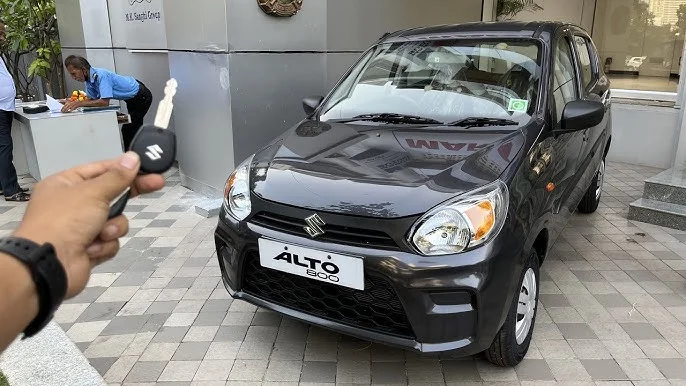
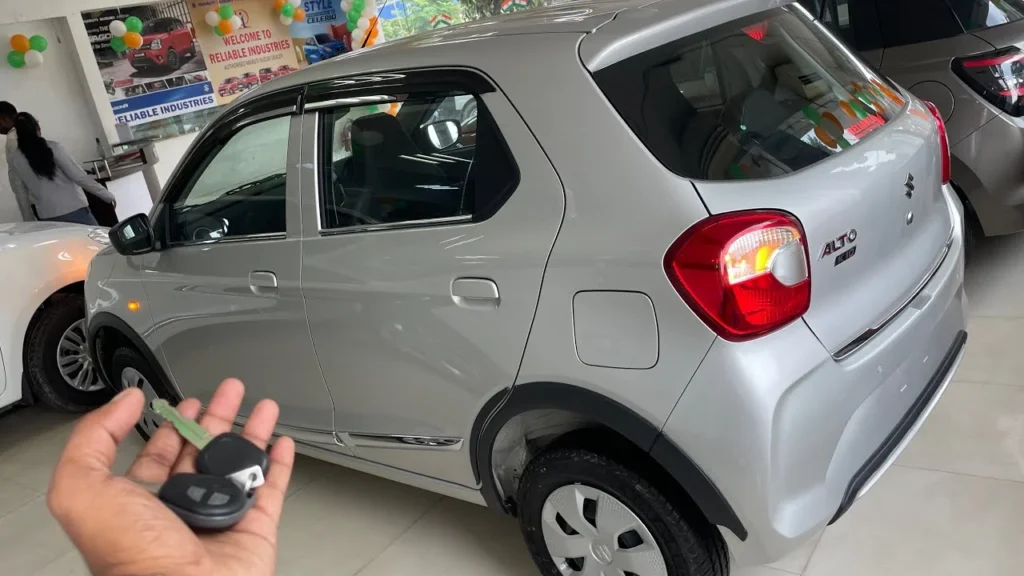
The 2025 update nudges the Alto’s styling to be a bit fresher — cleaner bumpers, updated grille cues and slightly modern headlamp graphics. Nothing dramatic; the change is more evolutionary than revolutionary. The aim is recognizability with a modest modern twist.
Colors, wheels and trim choices
Maruti keeps color choices practical: a mix of solid and metallic shades that hide city dust well. Wheel covers on base trims, some alloy-like options higher up — again, function over flamboyance.
Interior, comfort & practicality
Cabin layout and materials
Open the door and you’re greeted by a straightforward cabin: hard plastics, logically placed controls, and a dashboard designed to be simple to clean. It’s not premium — but it’s honest and built to last. The seats are tuned for short-to-medium commutes; headroom is decent for the class.
Space, boot and ergonomics
For a car of this size, the Alto uses its footprint well. Rear seat space is reasonable for two adults on short trips; boot space is compact but adequate for groceries and weekend bags. Clever small storage cubbies are the unsung heroes here.
Tech & convenience features
Infotainment, connectivity and convenience
Don’t expect a luxury infotainment stack. Higher trims may offer a basic touchscreen with smartphone connectivity or Maruti’s simpler infotainment units; Bluetooth, USB and aux are the everyday staples. Higher trims will score more cabin convenience features like power windows and central locking.
Climate, storage and useful bits
Air conditioning is effective for city use, which is what matters most here. There’s practical storage for your daily essentials and cup holders in sensible positions — small touches that make daily use less fussy.
Safety: what’s standard now
Airbags, ABS, ESC and the big safety push
Safety has become a bigger focus for mass-market cars in India, and Maruti has been updating its lineup accordingly. In 2025 the company made a notable move to standardize more safety hardware across its cars — including several Alto family updates like multiple airbags and stability aids. That means the Alto family is now noticeably safer than older, more minimal units.
Crash-worthiness and real-world safety
While hardware like multiple airbags and ESC are critical, crash results depend on bodyshell strength and device integration. The Alto’s updated safety kit makes it a far stronger contender in urban safety, but always check the latest evaluation results if safety is your top concern.
Running costs & ownership
Fuel economy expectations
The small 796cc engine makes the Alto cheap to run. Official and real-world figures vary, but city mileage is competitive for its class — often reported between low-20s to mid-20s kmpl for petrol; CNG options deliver even lower per-km cost if you have easy CNG access. Expect excellent fuel efficiency for daily city commute duty.
Service, parts and resale
Maruti’s vast network is a huge plus — service is affordable and spare parts are cheap and widely available. Resale values for the Alto historically hold up well because of demand in used-car markets and the model’s established reputation. That’s part of the total ownership math that keeps buyers coming back.
Pros & cons — who should buy it?
Best use-cases
- First car buyers on a strict budget
- City commuters who park in tight spots
- Fleet operators or drivers who value low running costs and simplicity
When to look elsewhere
- If you do frequent long highway runs or want 5+ adult-friendly space, look at larger hatchbacks like the Tiago or Grand i10 Nios
- If you prioritize luxury tech and premium interior finishes, this isn’t your playground
Competitors: how Alto 800 stacks up
The Alto’s main rivals are the Renault Kwid, Tata Tiago (a slightly bigger competitor), and entry-level offerings from Hyundai. The Alto’s trump card is price, backed by Maruti’s service and a vast dealer network. Competitors often offer more features at the same price, but Maruti’s reliability and low service cost usually offset that for many buyers.
Buying tips & final verdict
Best variant to choose
For most buyers the mid-tier variant makes sense — enough comforts (power steering, AC, some convenience features) without paying for extras you’ll rarely use. If you drive mostly city miles and have access to CNG, the CNG variant makes financial sense.
Negotiation & finance tips
- Compare dealer offers across multiple Maruti dealerships
- Ask for no-cost EMI or loyalty discounts if you’re exchanging a Maruti
- Factor in insurance and registration when calculating monthly budgets
Conclusion
The Maruti Alto 800 (2025) continues the classic recipe: extremely affordable, easy to run, and tailored for city life. The 2025 refresh keeps things practical while bringing important safety upgrades and modest modern touches. If your priorities are low cost of ownership, easy parking, and unbothered reliability, the Alto remains one of the smartest, simplest choices in its segment. If you want more space, power, or premium kit, you’ll happily pay more for a Tiago or Grand i10 — but you’ll also leave behind the Alto’s glorious thriftiness.
FAQs
Q1: What is the starting price of the Maruti Alto 800 (2025)?
A: The Alto 800’s ex-showroom prices start at approximately ₹3.25 lakh for the base petrol trims and can go up to around ₹5.12 lakh for higher CNG-equipped trims, depending on city and variant.
Q2: Which engine does the Alto 800 use and what mileage can I expect?
A: The Alto 800 typically uses a 796cc three-cylinder petrol engine, with power tuned for city use and real-world mileage often reported in the low-20s to mid-20s kmpl for petrol; CNG versions offer even lower running cost per km.
Q3: Are safety features like airbags and ABS standard on the 2025 Alto?
A: Yes, the 2025 Alto now includes safety essentials like airbags, ABS, and stability aids across variants, making it safer than older versions.
Q4: Is the Alto 800 a good first car?
A: Absolutely — if your priorities are affordability, low-running costs, easy parking, and a no-fuss ownership experience, the Alto is one of the best first-car choices in India.
Q5: How does the Alto compare to the Tata Tiago or Renault Kwid?
A: The Tiago is more feature-rich and safer, the Kwid offers stylish design, but the Alto wins on price, low maintenance, and Maruti’s unbeatable service network.

Azeem Aosaf is a visionary entrepreneur, digital strategist, and educator with a mission to empower individuals through online earning and digital innovation. As the CEO of HelixNex LLC, he leads multiple ventures across e-commerce, education, and fintech—helping people turn their digital skills into sustainable income. Through his educational initiative RankTrak, Azeem has trained hundreds of students in SEO, YouTube Automation, Freelancing, and AI-powered marketing. His work bridges technology and opportunity—creating a platform where learning meets real-world success. When he’s not mentoring students or building digital products, Azeem shares insights on entrepreneurship, marketing trends, and financial freedom through his blogs and social platforms. His core belief: “Your Growth, Our Mission.”