The Biggest Cloud Partnership in AI History
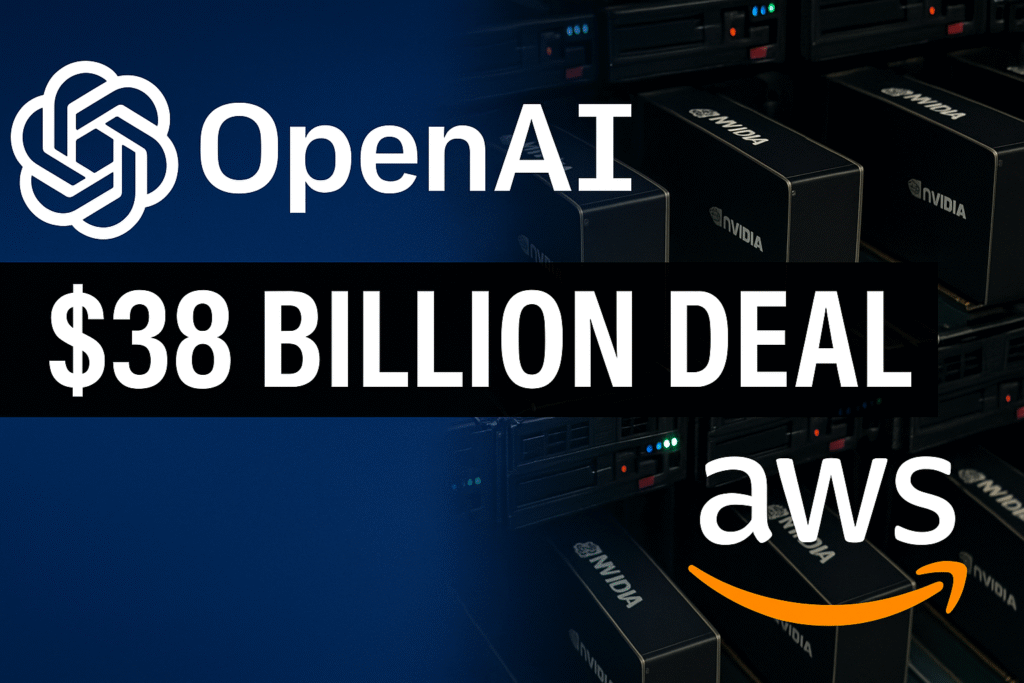
In one of the largest technology deals ever announced, OpenAI has entered into a seven-year, $38 billion agreement with Amazon Web Services (AWS).
The goal? To secure access to hundreds of thousands of Nvidia processors and millions of CPUs needed to train and deploy the next generation of artificial intelligence models — from ChatGPT successors to fully autonomous “AI agents” capable of performing complex tasks independently.
This partnership, revealed in early November 2025, marks a strategic shift for OpenAI. For years, the company relied primarily on Microsoft’s Azure cloud infrastructure. But now, by expanding to Amazon’s cloud ecosystem, OpenAI is reducing dependency and building a multi-cloud foundation for global scalability.
⚙️ What the $38 Billion Covers
At its core, this deal ensures massive computational stability for OpenAI’s future products. Let’s break it down:
- Nvidia GPU Access: OpenAI will utilize AWS data centers equipped with Nvidia’s GB200 and GB300 graphics processors — currently the most advanced chips for AI model training.
- Dedicated Cloud Infrastructure: AWS is providing OpenAI with exclusive high-performance clusters and next-gen networking to achieve low-latency model training at enormous scale.
- Flexible Compute Scaling: Over seven years, OpenAI can dynamically expand or reduce usage based on demand, giving it long-term cost control and technical flexibility.
- AI Research Enablement: The infrastructure will support both consumer-facing models like ChatGPT and research-level systems for robotics, image generation, and multi-modal intelligence.
In simpler terms, OpenAI just bought itself unlimited brainpower in the form of Amazon’s global compute resources.
Also Read This Apple’s Budget MacBook: Everything We Know About Apple’s Bold Move Into Affordable Laptops (Early 2026 Launch)
💡 Why This Partnership Matters
This isn’t just another corporate tech deal — it’s a global inflection point in how AI gets built and who controls the hardware behind it.
- The Rise of Compute as the New Gold
The future of AI depends less on software and more on who can access the fastest processors. Nvidia’s GPUs are the modern gold standard, and AWS happens to own one of the largest fleets in the world. - OpenAI’s Independence Strategy
After years of leaning heavily on Microsoft, this partnership shows OpenAI’s intent to diversify its infrastructure — ensuring resilience, competition, and innovation. - AWS Strengthens Its AI Credibility
For Amazon, this deal is a major comeback in the AI arms race. It proves that AWS isn’t just a cloud host — it’s a full-fledged AI powerhouse capable of supporting the world’s leading research labs. - Industry Ripple Effects
Expect other players like Google, Oracle, and IBM to follow suit with similar high-value AI cloud contracts. The race for “compute dominance” has officially begun.
🧠 What It Means for AI Development
OpenAI’s research is notoriously compute-intensive. Each new version of ChatGPT requires exponentially more processing power. With AWS’s infrastructure, the company can now train larger, more capable models faster — paving the way for:
- Real-time multimodal AI (understanding voice, video, and text together).
- Autonomous agent systems that can manage digital workflows.
- On-device AI acceleration for smaller, more efficient models.
This collaboration could drastically shorten AI development cycles — reducing the time from concept to public release.
In practical terms, users in the US, UK, and Canada may soon see faster ChatGPT responses, smarter personal assistants, and deeper AI integration across devices.
🏗️ How This Reshapes the Cloud Landscape
This deal underscores a new reality: cloud computing is now the backbone of artificial intelligence.
For years, OpenAI’s reliance on Microsoft Azure gave the Redmond giant a dominant share of the AI cloud market. Now, AWS is back in the spotlight, armed with scale and diversity that even Azure struggles to match.
🟩 AWS Benefits
- Gains credibility as an AI-first cloud provider.
- Attracts more enterprise customers building large-scale AI models.
- Strengthens partnerships with Nvidia and other hardware manufacturers.
🟦 OpenAI Benefits
- Diversifies compute resources across multiple partners.
- Reduces risk of supply bottlenecks.
- Gains access to AWS tools like SageMaker and Trainium for experimentation.
This symbiosis could set a new industry standard for cloud-AI cooperation — balancing competition with collaboration.
📅 Timeline of the Partnership
| Milestone | Timeline | Details |
|---|---|---|
| Deal Announcement | November 2025 | Officially confirmed by both OpenAI and AWS. |
| Initial Deployment | Q1 2026 | OpenAI begins using AWS infrastructure for model training. |
| Full Operational Scale | Late 2026 | GPU clusters and distributed compute pipelines go live. |
| Expansion Phase | 2027 – 2032 | Progressive increase in compute capacity tied to new model generations. |
⚠️ Potential Challenges
Even a $38 billion partnership doesn’t come without risks.
- Supply Chain Pressure: Nvidia chips remain in global shortage, meaning delays or cost overruns could occur.
- Energy Consumption: Running such vast data centers raises environmental concerns — expect sustainability scrutiny.
- Cost Efficiency: As AI models grow larger, even a billion-dollar infrastructure could struggle to meet compute demand.
- Regulatory Oversight: Governments in the UK, US, and EU are increasingly watching how large AI models use data and resources.
Still, both OpenAI and Amazon appear ready to address these hurdles head-on, leveraging renewable energy initiatives and optimized GPU utilization.
🧭 The Bigger Picture
This deal reflects a massive shift in global tech priorities. Computing power — once a back-end utility — is now the defining factor in who leads the AI revolution.
With OpenAI tapping into AWS’s scale, and Nvidia’s chips powering the engine, the future of artificial intelligence is entering its most advanced stage yet.
If successful, this partnership could mark the beginning of the “AI Industrial Era”, where every major advancement — from autonomous vehicles to language models — depends on cloud-level energy, scale, and coordination.
🧩 Key Takeaways
- Deal Value: $38 billion over seven years.
- Partners: OpenAI & Amazon Web Services.
- Core Hardware: Nvidia GB200/GB300 GPUs, millions of CPUs.
- Objective: Train next-gen AI models and expand global infrastructure.
- Outcome: Accelerates AI innovation, strengthens AWS’s AI position, and diversifies OpenAI’s compute strategy.
❓ Frequently Asked Questions (FAQ)
1. What makes this deal historic?
It’s one of the largest AI infrastructure commitments ever made, securing long-term compute power for OpenAI’s next generation of models.
2. Why did OpenAI choose AWS?
To expand beyond Microsoft Azure and ensure global scalability, redundancy, and cost flexibility.
3. What hardware will power OpenAI’s future models?
AWS’s servers with Nvidia’s latest GB-series GPUs — currently the world’s most powerful processors for deep learning.
4. Will this affect ChatGPT or other OpenAI tools?
Yes. Expect faster responses, better uptime, and the launch of more advanced features over time.
5. What does this mean for AI competition?
The deal intensifies rivalry among major tech companies, with AWS, Microsoft, and Google now locked in a global compute arms race.

Azeem Aosaf is a visionary entrepreneur, digital strategist, and educator with a mission to empower individuals through online earning and digital innovation. As the CEO of HelixNex LLC, he leads multiple ventures across e-commerce, education, and fintech—helping people turn their digital skills into sustainable income. Through his educational initiative RankTrak, Azeem has trained hundreds of students in SEO, YouTube Automation, Freelancing, and AI-powered marketing. His work bridges technology and opportunity—creating a platform where learning meets real-world success. When he’s not mentoring students or building digital products, Azeem shares insights on entrepreneurship, marketing trends, and financial freedom through his blogs and social platforms. His core belief: “Your Growth, Our Mission.”