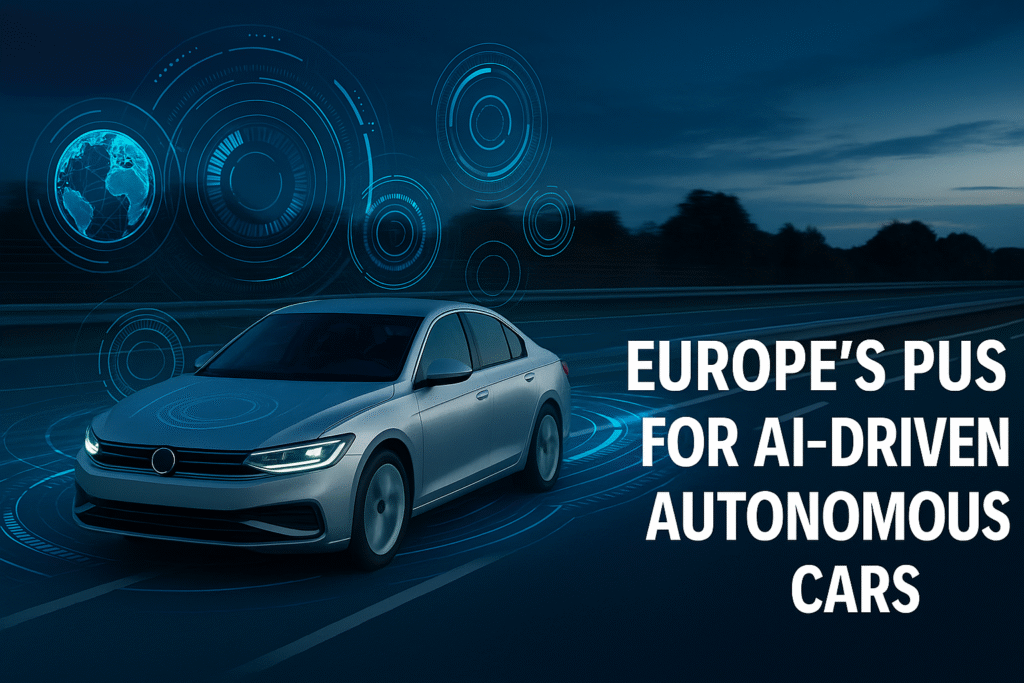
Europe is shifting gears toward a new era of intelligent mobility — one where cars don’t just drive people but think, decide, and react on their own. The European Union is making a bold push for AI-driven autonomous vehicles, aiming to compete head-on with the United States and China in the global self-driving race.
Through large-scale investments, public-private alliances, and advanced AI regulations, Europe is shaping a future that blends safety, sustainability, and innovation. But the road ahead — though exciting — is far from smooth.
🌍 Why Europe Is Accelerating Its Autonomous Ambitions
For decades, European carmakers have been global leaders in engineering and safety. But in the age of AI, software is becoming the new horsepower — and Europe is racing to catch up.
The European Commission has made autonomous mobility a strategic priority, driven by three key goals:
- Boosting road safety by reducing human error — still responsible for over 90% of traffic accidents.
- Strengthening industrial competitiveness against tech-heavy rivals like the US and China.
- Advancing climate and sustainability targets through intelligent, electric, and shared mobility systems.
The message is clear: the next revolution in cars will come from code, not combustion.
Read Also This: 🌍 Rapid Growth for Chinese Automakers in Europe: A Market Transformation in Motion
🧠 The Role of AI in Self-Driving Vehicles
AI sits at the heart of the self-driving revolution. European automakers and tech firms are working on systems capable of:
- Detecting road conditions in real time
- Predicting pedestrian and driver behavior
- Making split-second navigation and braking decisions
- Continuously learning through big data and machine learning models
By combining AI with LiDAR, radar, and 5G communication networks, these vehicles can communicate with infrastructure, other cars, and even city grids — creating a seamless digital ecosystem.
🏗️ The EU’s Roadmap for AI-Driven Mobility
1. Regulatory Sandboxes and Pilot Zones
To foster innovation without compromising safety, the EU has introduced “regulatory sandboxes” — designated areas where autonomous vehicles can be tested in real-world conditions under supervised frameworks.
Several cities in Germany, France, Spain, and the Netherlands are already hosting pilot programs featuring autonomous shuttles and delivery vans.
2. European Connected & Autonomous Vehicle Alliance (ECAVA)
A new coalition uniting automakers, AI companies, software developers, and regulators aims to establish standardized rules and shared data systems for all of Europe. This alliance is designed to prevent fragmentation and accelerate rollout.
3. Investment and Research Initiatives
Billions in funding are flowing through EU programs like Horizon Europe and the Digital Europe Initiative. The focus areas include AI safety, cybersecurity, smart infrastructure, and human-machine interaction.
4. AI Act: Setting Global Standards
Europe’s landmark AI Act is the world’s first legal framework for regulating artificial intelligence — including its use in vehicles. It categorizes self-driving systems as “high-risk,” ensuring they meet strict safety, transparency, and ethical standards.
This cautious but clear approach could make Europe a global model for responsible AI deployment.
🇬🇧 Beyond the EU: The UK’s Role in the AI Mobility Revolution
Post-Brexit Britain is charting its own course, but its goals are aligned with Europe’s. The UK government has set a target for fully self-driving vehicles by 2026, supported by trials in London, Coventry, and Milton Keynes.
British startups are partnering with established manufacturers to integrate AI algorithms, simulation models, and automated driving systems, creating a robust ecosystem that complements Europe’s larger efforts.
🤖 Key Players Driving Innovation
🏎️ Automakers
Companies like Volkswagen, BMW, Mercedes-Benz, and Stellantis are developing advanced driver-assistance systems (ADAS) that serve as stepping stones toward full autonomy.
💻 Tech Firms
AI innovators such as Wayve (UK), Valeo (France), and Bosch (Germany) are pioneering data-driven decision-making tools for real-time driving intelligence.
🚚 International Partnerships
Chinese and American companies like Pony.ai, Baidu, and Tesla are collaborating with European manufacturers to pilot robotaxi services and autonomous fleets. These partnerships help Europe gain access to proven technologies while maintaining regional oversight.
🌆 Real-World Testing and Urban Integration
From Paris to Helsinki, autonomous mobility pilots are already underway.
- Driverless taxis are being trialed in controlled urban zones.
- Autonomous delivery vans are transporting goods across logistics hubs.
- Smart traffic systems are learning to interact with self-driving fleets in real time.
These early deployments are helping policymakers identify regulatory gaps, improve AI safety standards, and gather crucial data for broader implementation.
⚠️ Challenges on the Road Ahead
While progress is accelerating, Europe’s autonomous vehicle dream still faces key roadblocks.
1. Regulatory Complexity
Different countries have different laws, creating a patchwork of approval processes that slow cross-border deployment.
2. Infrastructure Gaps
Not all roads are ready for autonomy — outdated traffic systems and inconsistent connectivity remain major obstacles.
3. Public Trust & Safety Concerns
Surveys show that many Europeans still don’t fully trust AI-driven cars. Winning consumer confidence through education and transparency will be vital.
4. High Development Costs
AI research, sensors, and testing facilities demand huge investments, and profitability is still years away for most automakers.
💡 The Opportunities Ahead
Despite the challenges, the benefits of autonomous mobility are too great to ignore:
- Fewer accidents and safer roads
- Reduced emissions through intelligent traffic management
- Greater accessibility for seniors and people with disabilities
- Job creation in AI, data analytics, and infrastructure development
- New economic ecosystems centered on smart cities and connected vehicles
If executed effectively, Europe could emerge not just as a participant but as a leader in the global AI mobility revolution.
🔮 The Road to 2030
Analysts predict that by 2030:
- 25–30% of new vehicles sold in Europe will have advanced self-driving features.
- Major cities will host fully autonomous ride-hailing and logistics services.
- The EU will establish a unified certification framework for Level 4 and Level 5 autonomy.
- Data-sharing between vehicles and public systems will be normalized — paving the way for smart, self-regulating mobility ecosystems.
💬 Final Thoughts
Europe’s push for AI-driven autonomous vehicles is more than a technological race — it’s a vision for a safer, smarter, and more connected society.
While regulatory caution and infrastructure hurdles may slow progress, the direction is undeniable: the steering wheel of innovation is firmly in AI’s hands.
The question isn’t whether self-driving cars will dominate Europe’s roads — it’s how fast Europe can adapt to drive that future.
❓ Frequently Asked Questions (FAQ)
Q1. Why is Europe focusing on AI-driven autonomous cars?
Because autonomous vehicles can improve road safety, reduce emissions, and strengthen Europe’s competitiveness in the global automotive market.
Q2. When will self-driving cars become common in Europe?
Pilot programs are already running, with commercial availability expected between 2026 and 2030, depending on regulation and infrastructure readiness.
Q3. How is Europe regulating AI in vehicles?
Through the AI Act, which sets rules for high-risk AI systems like autonomous driving, ensuring safety, transparency, and accountability.
Q4. Which countries are leading Europe’s self-driving efforts?
Germany, France, and the UK are at the forefront, followed by the Netherlands, Sweden, and Spain.
Q5. What benefits will AI-driven cars bring to consumers?
Safer travel, lower emissions, reduced congestion, and smarter transportation services like on-demand robotaxis and automated deliveries.

Azeem Aosaf is a visionary entrepreneur, digital strategist, and educator with a mission to empower individuals through online earning and digital innovation. As the CEO of HelixNex LLC, he leads multiple ventures across e-commerce, education, and fintech—helping people turn their digital skills into sustainable income. Through his educational initiative RankTrak, Azeem has trained hundreds of students in SEO, YouTube Automation, Freelancing, and AI-powered marketing. His work bridges technology and opportunity—creating a platform where learning meets real-world success. When he’s not mentoring students or building digital products, Azeem shares insights on entrepreneurship, marketing trends, and financial freedom through his blogs and social platforms. His core belief: “Your Growth, Our Mission.”