🌍 Two Processors, One Flagship Vision
Samsung’s upcoming Galaxy S26 lineup may bring back one of its most talked-about strategies — a split chipset design.
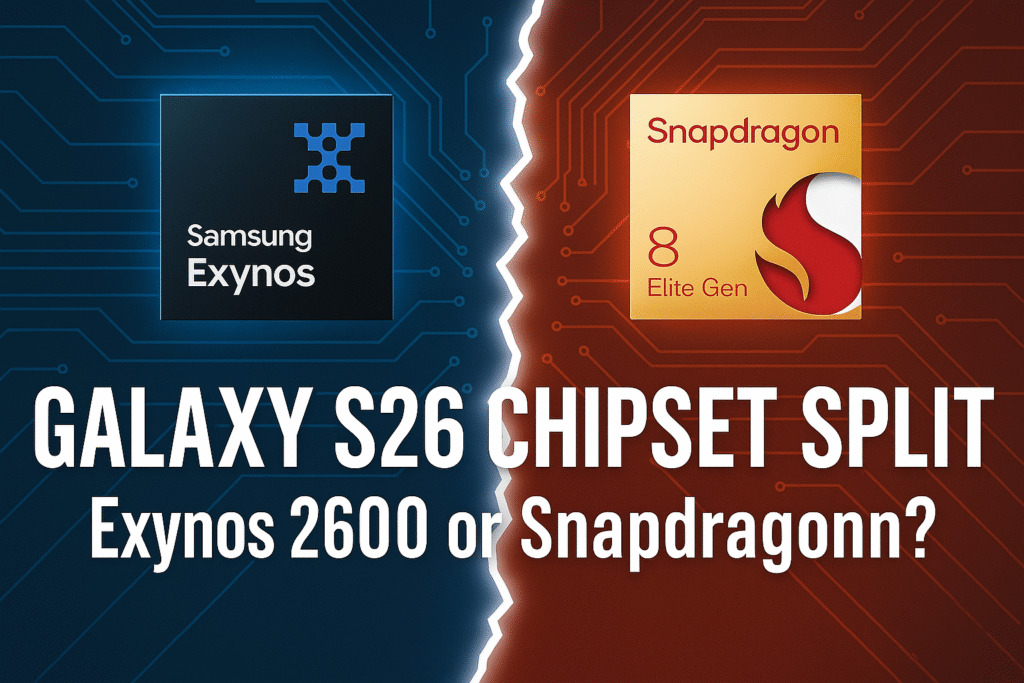
Leaks suggest that Samsung plans to use both its own Exynos 2600 and Qualcomm’s Snapdragon 8 Elite Gen 5 chips across different models and regions.
This move would mark a return to Samsung’s dual-chip approach after briefly standardizing Snapdragon across all Galaxy S24 models in 2024.
⚙️ What the Leaks Reveal
Multiple industry insiders claim Samsung is ready to diversify again:
- The Galaxy S26 Ultra (and possibly the U.S. and Chinese variants) will feature Qualcomm’s Snapdragon 8 Elite Gen 5, optimized for top-tier performance.
- The standard S26 and S26 Edge/Plus models are expected to run Samsung’s Exynos 2600, built on a new 2-nanometer process.
- The Exynos 2600 is rumored to include a 10-core CPU and an AMD-powered Xclipse GPU, delivering better thermal efficiency and stronger graphics than previous generations.
In short, Samsung is betting big on its latest silicon while keeping Qualcomm in its corner for markets where Snapdragon remains a customer favorite.
💡 Why Samsung Is Splitting Its Chip Strategy
1. Balancing Power and Profit
By producing and deploying its own Exynos chips, Samsung can reduce reliance on external suppliers and cut component costs — a key factor in an increasingly competitive smartphone market.
2. Regional Optimization
Samsung’s history shows that Snapdragon chips perform better on U.S. network bands, while Exynos handles international frequencies efficiently. This dual approach allows Samsung to tailor performance for each region’s infrastructure.
3. A Confidence Test for Exynos
After facing criticism for underperforming Exynos chips in earlier models, Samsung seems determined to prove that the 2600 series can compete head-to-head with Qualcomm’s best.
If successful, this could reestablish Samsung’s semiconductor credibility and position Exynos as a long-term alternative to Snapdragon.
Also Read this Samsung Confirms Cancellation of Galaxy S26 Edge, Ending the Curved-Flagship Line
📱 What This Means for Buyers
For consumers, the chipset you get may depend on where you live:
- U.S. & China: Snapdragon 8 Elite Gen 5
- Europe & South Korea: Exynos 2600
While both chips are expected to deliver flagship-level power, real-world differences in battery life, camera processing, and thermal performance will likely emerge.
Tech reviewers predict that while Snapdragon may still lead in raw efficiency, Samsung’s latest Exynos will close the gap — especially in GPU and AI computing performance.
🔋 Performance Expectations
Early reports suggest that the Exynos 2600 could outperform the Snapdragon 8 Gen 3 from last year, thanks to new AI-centric co-processors and improved energy-management algorithms.
The Snapdragon 8 Elite Gen 5, on the other hand, is expected to deliver record-breaking benchmarks — focusing on ray-tracing graphics, adaptive cooling, and real-time gaming optimization.
In short, both versions of the Galaxy S26 should feel equally premium, even if their internal hardware differs.
🌐 Samsung’s Bigger Picture
This dual-chip strategy is about more than just performance — it’s about ecosystem independence.
By refining Exynos while continuing to collaborate with Qualcomm, Samsung ensures flexibility in manufacturing and avoids supply-chain bottlenecks. It’s also part of the company’s broader plan to make its devices — from smartphones to tablets and laptops — run more efficiently under a unified chip architecture.
“Samsung isn’t just making phones anymore; it’s building an ecosystem powered by its own intelligence.”
✅ The Bottom Line
The Galaxy S26 marks a pivotal moment for Samsung’s flagship lineup. Instead of chasing a one-size-fits-all chipset, the company is tailoring performance for different audiences.
If the Exynos 2600 delivers on its promise, 2025 could be the year Samsung redefines its reputation as both a smartphone and semiconductor leader.
Whether you buy the Snapdragon or the Exynos version, one thing’s clear — the Galaxy S26 is shaping up to be the most advanced Android phone yet.
🔍 Frequently Asked Questions (FAQ)
1. Why is Samsung using two different processors in the Galaxy S26 series?
Samsung is reviving its dual-chip strategy to balance cost, performance, and supply flexibility. By combining its in-house Exynos 2600 with Qualcomm’s Snapdragon 8 Elite Gen 5, Samsung can optimize each model for regional networks and reduce dependency on a single chip supplier.
2. Which Galaxy S26 models will use Exynos and which will use Snapdragon?
Leaks suggest the Galaxy S26 Ultra and devices sold in the U.S. and China will run on Snapdragon 8 Elite Gen 5, while the standard S26 and S26 Edge/Plus — especially in Europe and South Korea — will feature Samsung’s Exynos 2600 chipset.
3. What’s new about the Exynos 2600 chip?
The Exynos 2600 is reportedly built on a 2-nanometer process, boasting a 10-core CPU and a next-gen AMD-based Xclipse GPU. It’s expected to deliver faster performance, improved energy efficiency, and more advanced AI computing capabilities compared to earlier Exynos versions.
4. Will the Snapdragon and Exynos versions perform differently?
Performance differences are expected to be smaller than in previous Galaxy generations. Both chips are designed for flagship-level speed, though Snapdragon may still lead slightly in thermal management and gaming performance. Samsung has heavily optimized the Exynos 2600 to close the gap.
5. Should buyers worry about which version they get?
Not necessarily. Both variants are designed to deliver premium experiences — from camera processing to AI features. Unless you’re a power user comparing benchmark scores, the differences in daily performance and battery life are likely to be minimal.

Azeem Aosaf is a visionary entrepreneur, digital strategist, and educator with a mission to empower individuals through online earning and digital innovation. As the CEO of HelixNex LLC, he leads multiple ventures across e-commerce, education, and fintech—helping people turn their digital skills into sustainable income. Through his educational initiative RankTrak, Azeem has trained hundreds of students in SEO, YouTube Automation, Freelancing, and AI-powered marketing. His work bridges technology and opportunity—creating a platform where learning meets real-world success. When he’s not mentoring students or building digital products, Azeem shares insights on entrepreneurship, marketing trends, and financial freedom through his blogs and social platforms. His core belief: “Your Growth, Our Mission.”